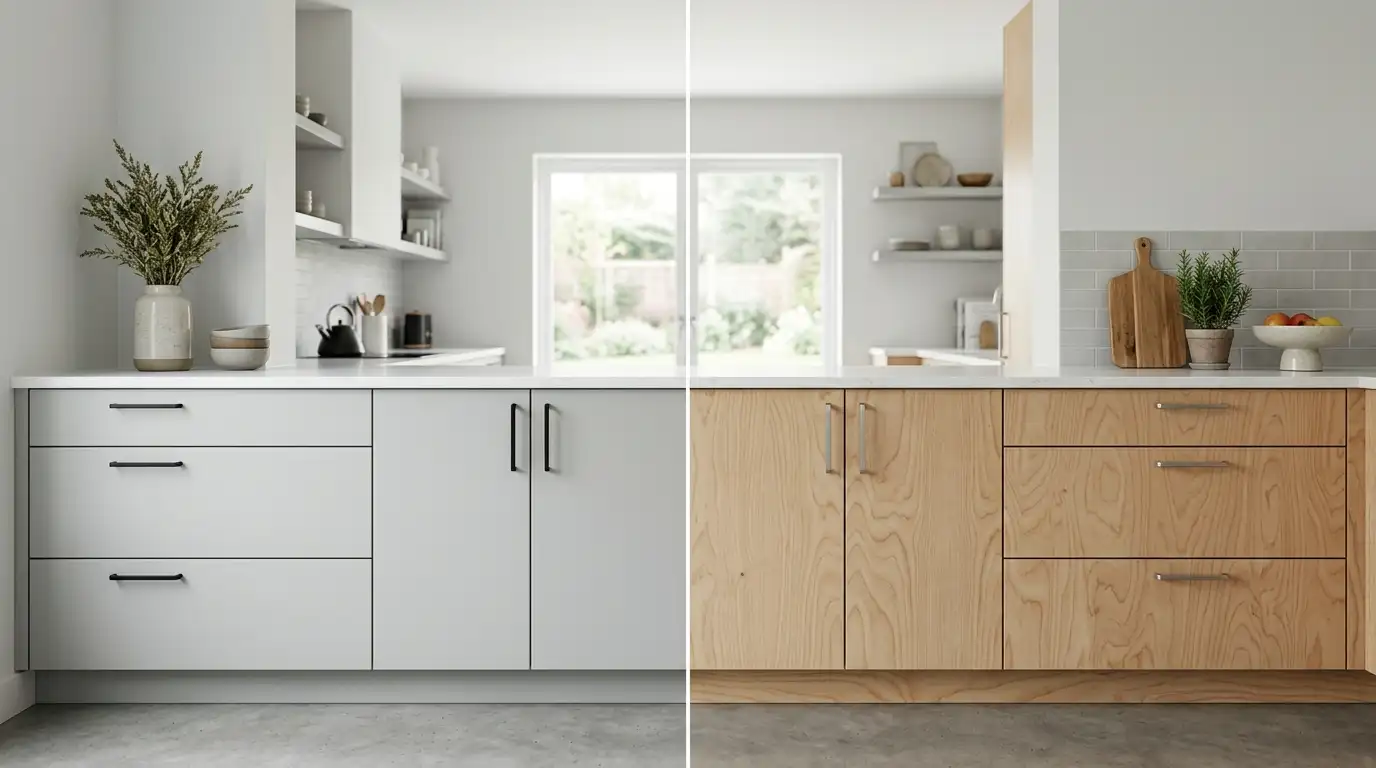
Plywood holds up better in kitchens, garages, and bathrooms because it resists moisture and grips screws for years. MDF costs less and paints smoother, making it a smart pick for dry spaces like closets or painted door fronts. Your best cabinet material depends on the room, not just the price tag.
The MDF vs plywood cabinets debate is hardly new. Ask three cabinet shops, and there is a good chance you will hear three slightly different opinions. Part of the confusion comes from the fact that both materials are used in quality cabinetry every day. The real difference usually shows up years later, after the cabinets have been exposed to moisture, heavy use, and everyday wear. That is where the question of mdf vs plywood which is better, starts to make a lot more sense.
What Is MDF?
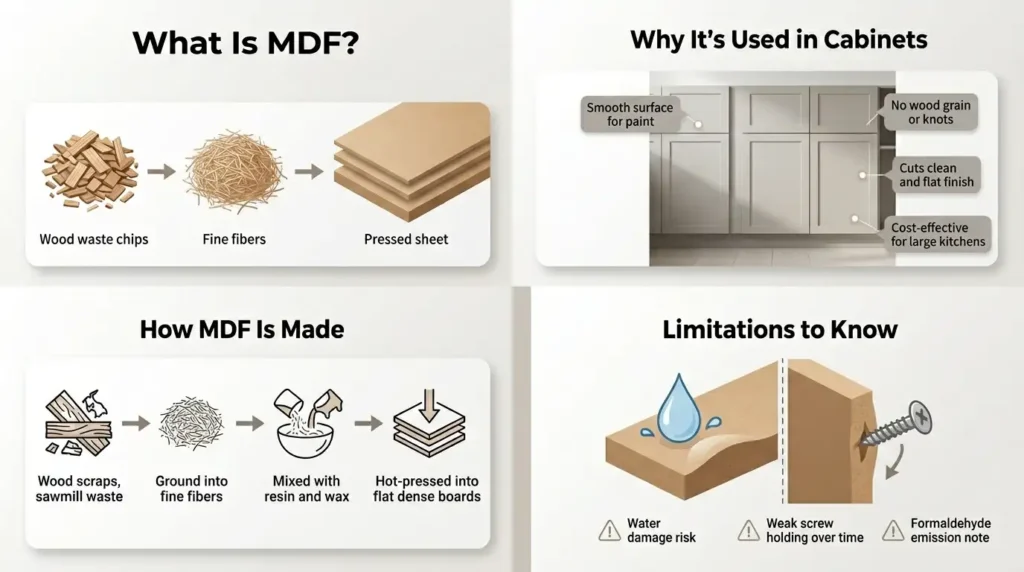
MDF starts as wood scraps and sawmill waste. Manufacturers grind it into fine fibers, mix in resin and wax, and press everything under heat into dense, flat panels. No grain, no knots, same result every sheet.
That makes it genuinely good for painted work. It lies flat, cuts clean, and holds paint without the prep work plywood needs. Cost lands between $40 and $150 per linear foot, so on a large painted kitchen, it becomes the smarter call in any cabinet material comparison.
Two real problems: water ruins it fast and edge screws strip out over time. Cheaper MDF also off-gasses formaldehyde for months after install. For any indoor build, look for panels that meet CARB Phase 2 certification standards. The California Air Resources Board sets those limits and explains exactly what the certification covers.
What Is Plywood?
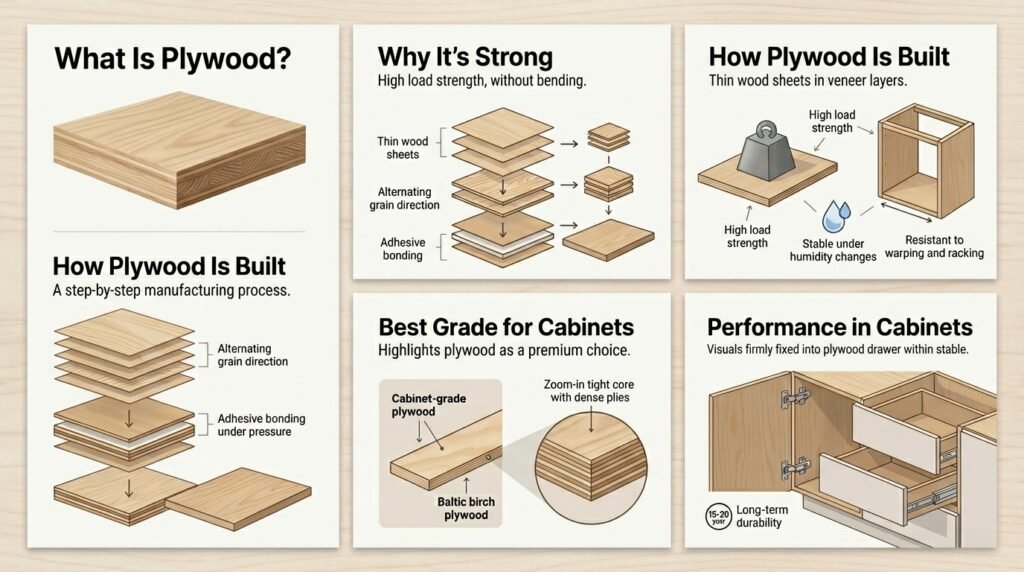
Plywood is basically thin wood sheets glued together in alternating directions. That layered build is what makes it so tough. It takes weight, handles racking, and does not fall apart when humidity goes up the way MDF does.
For cabinet boxes, you want cabinet-grade, not the stuff sitting in stacks at your local home center. Baltic birch is what most good builders reach for. More plies, tighter core, and it actually holds up to daily use. Standard construction plywood is a different animal entirely.
Here is where plywood vs MDF for cabinets gets settled for a lot of people: screw holding. Hinges stay where you put them. Drawer slides do not drift. Hardware you use ten times a day stays tight for 15 to 20 years. That is not nothing in a busy kitchen. It costs more and needs a bit of prep before paint, but you are getting real longevity for that price.
MDF vs Plywood Cabinets: Side by Side
This cabinet durability comparison covers everything that actually moves the needle on a buying decision.
| Factor | MDF | Plywood |
|---|---|---|
| Cost per linear foot | $40 to $150 | $60 to $225 |
| Paint finish | Smooth, no grain bleed | Needs sanding and primer |
| Moisture resistance | Poor, swells permanently | Good, handles daily humidity |
| Screw holding | Weak near edges | Strong, stays tight for years |
| Weight (3/4 inch 4×8 sheet) | Around 97 lbs | Around 60 lbs |
| Stainable | No | Yes |
| VOC emissions | Higher without CARB cert | Lower, FSC options available |
| Lifespan in humid spaces | 7 to 12 years | 15 to 25 years |
| Best use | Painted doors, dry closets | Cabinet boxes, kitchens, garages |
| Resale value impact | Neutral | Positive, seen as premium |
Which Is Better for Kitchen Cabinets?
Kitchens are hard on everything. Steam, dishwasher humidity, sink splash, fridge condensation every single day. MDF does not hold up reliably against any of it. A slow leak that nobody catches for a few days causes permanent swelling in an MDF box. Once it goes, it is gone.
For anyone asking which is better MDF or plywood for kitchen cabinets, the carcass settles it. Plywood handles daily moisture, holds its shape, and keeps hardware tight for years. Choosing wrong here ranks among the most costly kitchen remodeling mistakes you can make, because swapped-out cabinet boxes cost far more than MDF ever saved.
MDF still works great on painted door fronts in dry zones. Flat, smooth, and a finish that looks factory-made. For white shaker or any painted flat panel style, MDF faces beat plywood without the extra prep.
Engineered Wood vs Solid Wood: Where Do These Two Land?
Both are engineered wood products. Solid wood runs $500 to $1,200 per linear foot and moves with seasonal humidity. The engineered wood vs solid wood conversation is mostly about stability and cost. Plywood sits closer to solid wood behavior than MDF does, at a much lower price.
The plywood cabinets vs MDF cost comparison shifts completely when you factor in lifespan. MDF lasts 7 to 12 years in humid spaces, plywood lasts 15 to 25. On a 20-linear-foot kitchen, the upfront gap is $200 to $600, but the cost per year across the cabinet lifespan often favors plywood by a wide margin. That is the real mdf vs plywood cabinets pros and cons calculation.
Moisture Resistant Cabinets: The Numbers Matter
MDF begins swelling at around 70 percent relative humidity sustained over time. Kitchens and bathrooms in US homes hit 60 to 80 percent RH regularly during cooking and showering, especially in the South and Pacific Northwest. That is not unusual. It is a typical week at home.
Moisture-resistant plywood with exterior-grade glue holds up to roughly 85 percent RH without delaminating when edges are sealed. Nobody asks which cabinet material is waterproof MDF or plywood, and gets a satisfying answer because neither one is fully waterproof. But plywood handles sustained humidity and minor leaks far better, while MDF swells permanently from standing water. That difference in moisture-resistant cabinet performance is why professionals spec plywood for the carcass even on tight budgets.
Best Cabinet Material for Closets and Garage Cabinets
Dry bedroom closets are the perfect spot for MDF, even though it may not be the best material for cabinets in areas exposed to moisture. Stable temperature, light loads, painted finish, zero moisture. The savings are real, and none of the weaknesses show up. Custom closet makers in Idaho Falls use MDF in dry spaces regularly because it just makes sense there.
Garages are a different story entirely. Idaho Falls garages swing from below zero in January to 90-plus in July, with rain, humidity, and open doors all summer mixed in. Is plywood better than MDF for cabinets in a garage? There is no contest. Custom garage cabinetry services built on plywood handle every one of those swings without warping, swelling, or losing fastener grip.
Resale Value: A Gap Most Articles Skip
Plywood cabinets get called out in real estate listings as a selling point. Buyers see them as a quality indicator. MDF is not a dealbreaker, but it does not add the same value.
Selling within 10 years? Plywood recovers more of its cost at closing. That should factor into how you weigh the upfront price gap from the beginning.
The Hybrid Approach Works Best
The difference between MDF and plywood cabinets in detail is this: neither wins everywhere. The best builds use both. Plywood for the structural carcass requires moisture resistance, strength, and screw-holding to keep everything working for decades. MDF on door fronts and panels, where a smooth, grain-free painted finish is the whole point.
High-end shops build this way as standard. You get 20-plus years from the plywood structure and a finish on the doors that looks custom. A built-in furniture maker applies the same logic, matching material to function on every part.
Check standard cabinet dimensions before you spec anything so your sheet quantities are accurate. If you are still deciding on build type, the custom vs RTA cabinets breakdown is worth a read. Most RTA cabinets go all-MDF to cut costs. Fine for a spare room. In a kitchen or garage, that usually means earlier replacement.
For cabinets that actually last, custom cabinetry solutions from Knudson Cabinetry mean the right material matched to the job from day one.
Frequently Asked Questions
Which is better for kitchen cabinets, MDF or plywood?
Kitchen cabinets deal with a lot more moisture than most people realize. Between cooking, dishwashers, and the occasional plumbing issue, plywood tends to hold up better over time. MDF is more commonly used for painted cabinet doors rather than the cabinet boxes themselves.
Why do some cabinet makers still use MDF?
Because it works really well in the right places. MDF has a smooth surface that paints beautifully and doesn’t show wood grain. For painted doors, decorative panels, and closets, it can be a very practical choice.
What happens if MDF gets wet?
A little splash that gets wiped up right away usually isn’t a problem. The trouble starts when water sits on the material or gets into exposed edges. Once MDF swells, it generally can’t be restored to its original condition.
Is plywood always worth paying more for?
Not necessarily. For a guest closet or another dry area, MDF may provide everything needed at a lower cost. In kitchens, bathrooms, and garages, however, many homeowners find the extra investment in plywood worthwhile.
Why is plywood considered a premium cabinet material?
Much of it comes down to durability. Plywood is strong, lightweight, and does a good job holding screws and hardware in place over the years. Those qualities have made it a popular choice for custom cabinetry for decades.
Should cabinets be made from only one material?
Not always. Many high-quality cabinets use a combination of materials. A common approach is plywood for the cabinet structure and MDF for painted doors, allowing each material to be used where it performs best.
Conclusion
MDF vs plywood cabinets has no single winner. Plywood belongs in kitchens, bathrooms, and garages where moisture and load are daily realities. MDF belongs on painted door faces and dry spaces like closets, where the low cost and smooth surface are actual advantages. The best cabinet builds use both, with each material doing the job it is actually suited for.
Want it built right from the start? Talk to the team at Knudson Cabinetry and get a custom build that lasts.