Here is the thing nobody tells you before a kitchen remodel.
Cabinet dimensions are not exciting. They are not the fun part. But get them wrong and you are stuck with gaps between cabinets, a countertop sitting too high, or wall cabinets that look weirdly low. Fixing that after the fact costs real money.
So before you pick a style or a finish or anything else, learn the numbers. This cabinet sizes guide covers everything. Base cabinets, wall cabinets, tall cabinets, pantry cabinets, vanity cabinets. Plain measurements, no nonsense.
Why Does Any of This Get Standardized?
Good question actually.
A kitchen operates as an integrated system. The existence of standard kitchen cabinet sizes results from the fixed needs of countertops and appliances and the people who use those items. Most adults find a 36-inch countertop height to be suitable for their needs. Standard appliance cutouts are designed to match the dimensions of standard cabinet openings. When everything follows those numbers the kitchen fits together cleanly.
When it does not, you are buying filler cabinets to hide the gaps. Not a great look.
Base Cabinet Dimensions
Base cabinets sit on the floor. They carry the countertop and anchor the whole kitchen layout.
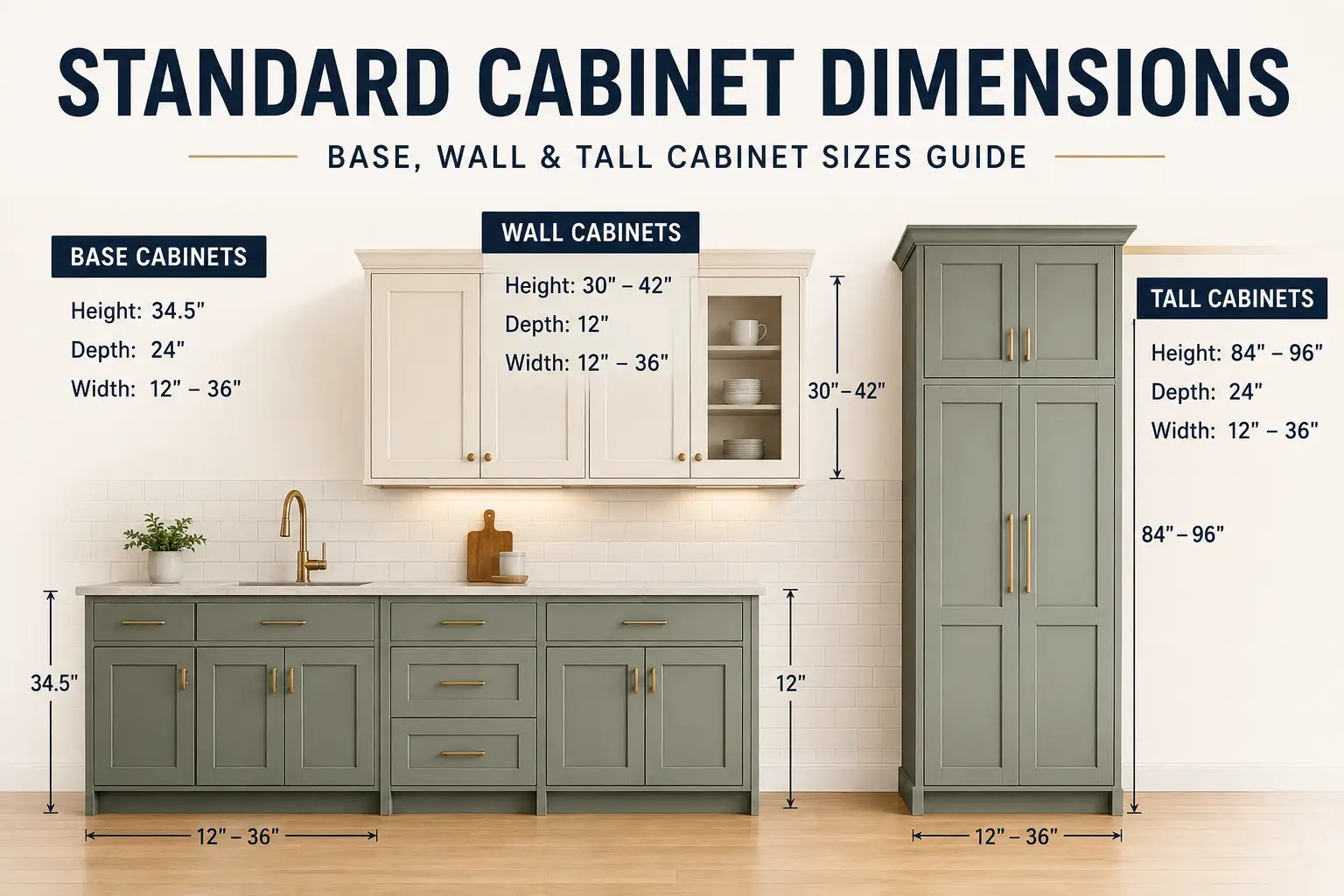
How tall are standard base cabinets? The cabinet box itself sits at 34.5 inches. Add a countertop and you land at 36 inches. That is the number everything else gets built around.
Standard cabinet depth for a base cabinet is 24 inches. Standard cabinet width runs from 9 inches all the way to 48 inches in 3-inch increments.
| Measurement | Standard Size |
|---|---|
| Height without countertop | 34.5 inches |
| Height with countertop | 36 inches |
| Depth | 24 inches |
| Width range | 9 to 48 inches |
| Width increments | 3 inches |
The toe kick sits at the very bottom of the base cabinet. It is 3.5 inches tall and 3 inches deep. Without it you would stub your toes on the cabinet box constantly.
Other base cabinet things worth knowing:
- Sink base cabinets need to be wider for plumbing. Common widths are 30, 33, and 36 inches
- Corner base cabinets run 36 by 36 inches to handle the turn in the layout
- Drawer base cabinets come in 12, 15, 18, and 24-inch widths
- Narrow layouts sometimes drop to 12-inch depth instead of the standard 24
Wall Cabinet Dimensions
Wall cabinets mount above the countertop. Upper cabinet dimensions show more variation than base cabinets because different homes have different ceiling heights.
How tall are upper kitchen cabinets? Most kitchens have 30 or 36-inch-tall wall cabinets. The 30-inch cabinets create an overhead space that shows when you have an 8-foot ceiling. The 36-inch option brings greater proximity while providing additional storage space.
How high are wall cabinets installed above the countertop? Standard installation puts the bottom of the wall cabinet 18 inches above the countertop surface. The design enables users to operate kitchen appliances without obstruction while keeping upper cabinets within their reach.
Standard cabinet depth for wall cabinets is 12 inches. Standard cabinet height options run from 12 inches all the way up to 42 inches, depending on ceiling height and personal preference.
| Measurement | Standard Size |
|---|---|
| Height options | 12, 15, 18, 24, 30, 36, 42 inches |
| Depth | 12 inches |
| Width range | 9 to 48 inches |
| Width increments | 3 inches |
Wall cabinet height by ceiling height, quick guide:
- 8-foot ceiling: 30 or 36-inch wall cabinets work well
- 9-foot ceiling: 36 or 42-inch wall cabinets fill the space better
- 10-foot ceiling: 42-inch cabinets plus a filler cabinet above or open display space
Tall Cabinet Dimensions
Tall cabinets go floor to ceiling. They handle pantry storage, utility storage, or housing built-in appliances like wall ovens and refrigerators.
Standard cabinet height for tall cabinets runs at 84, 90, or 96 inches depending on ceiling height. Standard cabinet depth varies more than other cabinet types because different uses need different depths.
| Measurement | Standard Size |
|---|---|
| Height | 84, 90, or 96 inches |
| Depth | 12 to 24 inches |
| Width range | 18 to 36 inches |
| Width increments | 3 inches |
A filler cabinet used to close awkward gaps between other cabinets might be as narrow as 3 inches wide. Pantry cabinets that match base cabinet depth run the full 24 inches. Cabinet height, width, depth all shift based on what the tall cabinet is actually doing in the layout.
Pantry Cabinet Dimensions
What is the standard height of a pantry cabinet? Most sit between 84 and 96 inches tall, 24 inches deep, and 18 to 36 inches wide.
| Measurement | Standard Size |
|---|---|
| Height | 84 to 96 inches |
| Depth | 24 inches |
| Width | 18, 24, 30, or 36 inches |
A pantry cabinet next to a refrigerator or at the end of a run uses every inch of that wall.
Upper vs Lower Cabinet Dimensions
Lower cabinet dimensions and upper cabinet dimensions are different on purpose.
Lower cabinets go 24 inches deep to carry the countertop load. Upper cabinets go 12 inches deep to stay within reach.
The face frame on each cabinet creates a consistent visual line across both. Behind that face frame though the cabinet box on an upper and the cabinet box on a lower are completely different animals.
Bathroom Vanity Cabinet Dimensions
Bathroom vanity cabinet dimensions differ from kitchen base cabinet dimensions mainly because they are shorter.
Standard height sits between 31 and 35 inches. Comfort height vanity cabinets run 34 to 36 inches and are getting more common because they are just easier on your back during daily use.
| Measurement | Standard Size |
|---|---|
| Height | 31 to 35 inches |
| Depth | 17 to 24 inches |
| Width | 24 to 72 inches |
Depth varies with sink size and plumbing setup. A small half bath might use a 17-inch deep vanity cabinet. A large master bathroom might go the full 24 inches to fit a bigger sink basin and more storage underneath.
Quick Reference Cabinet Size Chart
Here is the full cabinet size chart in one place. Print it out if that helps.
| Cabinet Type | Height | Depth | Width Range |
|---|---|---|---|
| Base cabinet | 34.5 inches | 24 inches | 9 to 48 inches |
| Wall cabinet | 12 to 42 inches | 12 inches | 9 to 48 inches |
| Tall cabinet | 84 to 96 inches | 12 to 24 inches | 18 to 36 inches |
| Pantry cabinet | 84 to 96 inches | 24 inches | 18 to 36 inches |
| Vanity cabinet | 31 to 35 inches | 17 to 24 inches | 24 to 72 inches |
| Filler cabinet | Matches adjacent | 12 to 24 inches | 3 to 6 inches |
| Sink base cabinet | 34.5 inches | 24 inches | 30 to 36 inches |
How to Measure for New Cabinets
How to measure an area for new cabinets is simpler than people think. Get the numbers before anything gets ordered.
What to write down before you do anything else:
- Total wall length measured in linear foot increments
- Exact location of windows, doors, vents, and pipes
- Ceiling height so you know which wall cabinet and tall cabinet heights actually fit
- Whether walls are square, older homes are often not and that matters more than people expect
- Appliance cutout sizes for your dishwasher, refrigerator, and range before cabinets get finalized
Cabinet height, width, depth all need to work together. Do not trust your memory on any of this.
When Standard Cabinet Dimensions Do Not Work
Standard cabinet dimensions handle most kitchens. Not all though.
Older homes with irregular walls or unusual ceiling heights often need something a catalog just does not carry. A custom cabinet manufacturer builds to your exact numbers. No gaps, no filler strips, no workarounds.
Garages are a classic example of where standard sizing falls apart. Posts in awkward spots, wall lengths that do not match standard cabinet widths, storage needs that a basic base cabinet box cannot handle. If any of that sounds familiar, looking at garage cabinetry services designed around your actual space is a smarter starting point.
When Built-Ins Beat Cabinets
Sometimes the right answer is not a cabinet at all.
Window seats with storage, built-in shelving, custom media units. These follow their own cabinet dimensions rather than kitchen standards. If your project does not fit the standard cabinet sizes guide, Idaho Falls custom furniture built around your specific wall or room is probably closer to what you actually need.
Do You Need Custom Cabinets?
Honestly most people do not. Standard cabinet dimensions cover the majority of kitchens and bathrooms just fine.
But if your space is unusual, if you want specific joinery and materials, or if you want a custom cabinet manufacturer to build something that genuinely fits your home rather than something you adapt your home around, that conversation is worth having.
The best cabinet maker in the United States builds to your kitchen rather than the other way. You notice that difference on day one and every day after.
To Wrap It Up
Cabinet dimensions are not complicated. Once you know the baseline numbers the rest of the planning gets a lot easier.
Base cabinets at 34.5 inches tall and 24 inches deep. Wall cabinets at 12 inches deep, installed 18 inches above the countertop. Tall and pantry cabinets at 84 to 96 inches. Vanity cabinets a few inches shorter than kitchen base cabinets.
Get the standard cabinet dimensions right first. Everything else in the layout follows from there.
Frequently Asked Questions
What are standard cabinet door and drawer heights?
Doors on base cabinets run the full height of the cabinet box, somewhere between 24 and 30 inches depending on drawer configuration. Common drawer heights are 6, 7.5, and 10 inches. A standard three-drawer base cabinet stacks those to fill out the 34.5-inch cabinet height.
Are RTA cabinets the same dimensions as standard cabinets?
Yes. Ready-to-assemble cabinets follow the same standard cabinet dimensions as assembled ones. Difference is in how they ship and get put together, not in the actual sizing. A 30-inch wide RTA base cabinet is the same width as a 30-inch assembled cabinet.
Can cabinet dimensions be customized?
Yes. A custom cabinet manufacturer builds to whatever dimensions you need. Height, depth, width, all adjustable. Most useful in older homes where walls are not square or ceiling heights do not line up with standard sizing increments.