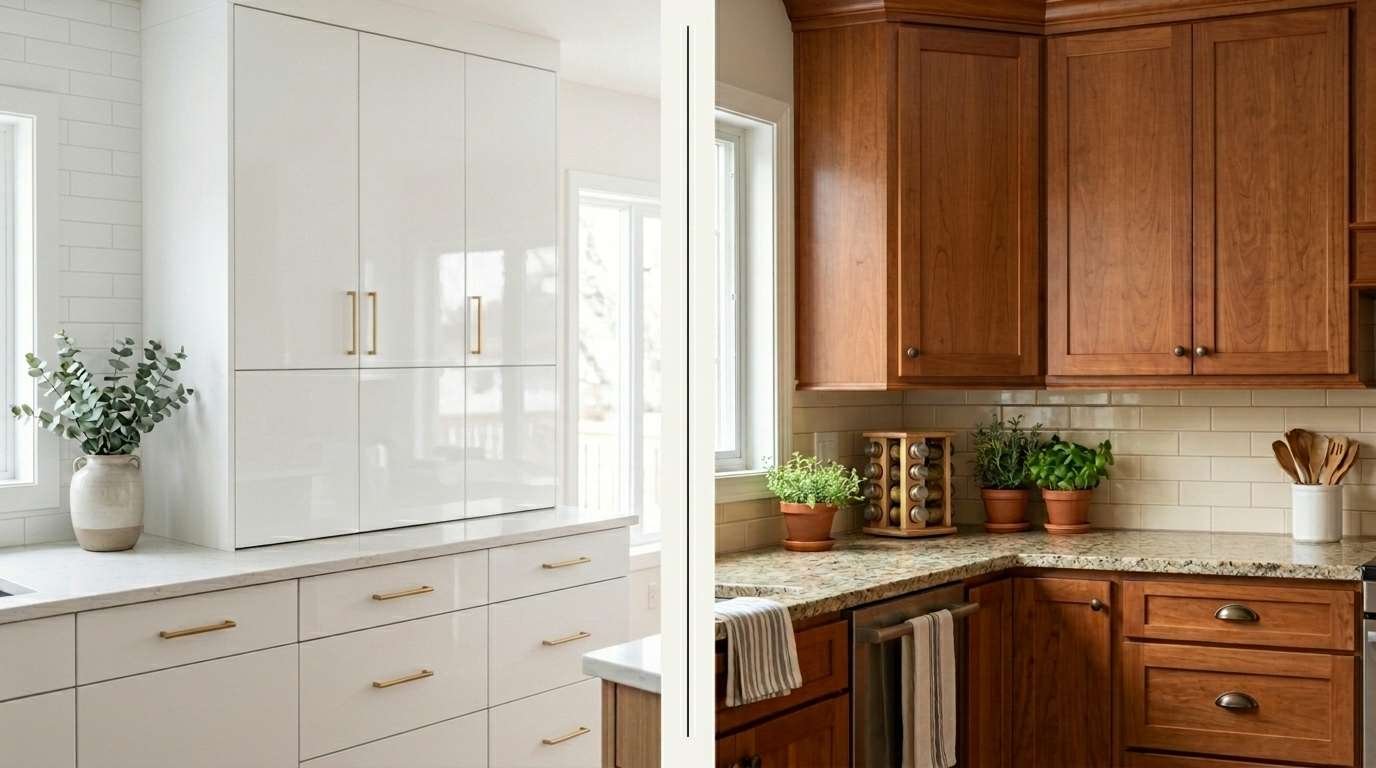
You are picking cabinets, and someone mentions framed vs frameless. Maybe your contractor used the phrase. Maybe you saw it on a product page. Either way, you need to know what it actually means before you spend any money.
Here is the plain breakdown of framed vs frameless cabinets. What each one is, how the construction differs, and which makes more sense for your kitchen.
What Is a Framed Cabinet and How Is It Built?
So what is a framed cabinet exactly? It has a face frame attached to the front of the cabinet box.
That face frame is built from horizontal pieces called rails and vertical pieces called stiles. It wraps around the cabinet opening and gives the door something solid to mount against.
This is the American-style cabinet. Framed cabinet construction has been the default in US homes for decades.
The reveal is the small visible gap between the door edge and the face frame. Cabinet door overlay options determine how much of the frame shows. Standard overlay covers a little. Full overlay covers most of it. The inset overlay puts the door flush inside the frame opening completely.
What Is a Frameless Cabinet and How Does It Differ?
What is a frameless cabinet? Simply put, it has no face frame. Doors mount directly onto the cabinet box.
This is the European-style cabinet. It developed in postwar Europe when materials were tight, and efficiency mattered. That is why frameless cabinets are called European cabinets even when they are made domestically.
Without a face frame blocking the opening, you get the full width of the cabinet box to work with. That is where the storage claim comes from.
Frameless cabinet construction requires a thicker and stronger cabinet box to handle racking. What is racking in cabinet construction? It is the tendency of the box to lean or twist under load. A face frame controls that on framed cabinets. On frameless cabinets, the box itself has to do that job.
Full Overlay vs Inset: How They Look Different
Full overlay vs inset and face frame vs frameless are closely connected conversations.
Full overlay covers nearly all of the face frame. The kitchen looks clean and continuous. Inset sits flush inside the frame opening and gives a traditional furniture-like appearance. Both are only possible because the face frame exists to work with.
Frameless cabinets use full overlay by default. There is no frame to inset into, so the door simply covers the full box opening every time.
The Difference Between Framed and Frameless Cabinets in Storage
The difference between framed and frameless cabinets on storage is real but small.
A face frame eats about an inch of usable opening on each side. Frameless gives you the full cabinet box width. For most items, that gap is barely noticeable. Where it matters is pull-out drawers and organizers. Frameless accommodates these more easily because nothing interrupts the opening.
Can you put glass doors on frameless cabinets? Yes, glass doors work on both. On frameless, the look is cleaner because there is no frame surrounding the opening.
Framed vs Frameless Cabinets Cost
Frameless cabinets generally cost more.
The thicker cabinet box material needed to replace what the face frame does structurally costs more and weighs more. Framed cabinets use thinner box material because the face frame carries some of the load. That makes framed construction less expensive at comparable quality levels.
The gap narrows at the custom level, where framed vs frameless cabinets pros and cons matter less than the quality of what goes into the build.
Frameless Cabinets Vs Framed Pros and Cons: Side by Side
Framed cabinets:
- Standard in American kitchens and easy to source
- Less expensive than frameless at comparable quality
- Face frame controls racking and adds structural rigidity
- Offers inset, standard overlay, and full overlay options
Frameless cabinets:
- Full overlay is standard, giving a cleaner, modern look
- Slightly wider cabinet opening for pull-out storage
- Cabinet box must be thicker to handle racking without a face frame
- Better suited to contemporary and minimalist kitchen styles
Which One Works Better for a Small Kitchen?
Frameless cabinets give a small kitchen a cleaner visual line. Full overlay doors with no frame showing creates a more continuous look across the cabinet run.
Are frameless cabinets better than framed? Not necessarily. A framed kitchen with full overlay doors looks nearly identical. Layout and overlay choice matter more than frameless cabinets vs framed construction in small spaces.
Built-in closet systems follow the same framed versus frameless trade-offs. If you are thinking about a closet project alongside your kitchen, looking at custom closets vs ready made closets first helps you apply the same thinking before committing.
Getting It Built Right
Frameless cabinets vs framed is less important than build quality. Both can be built well or badly.
What matters is the cabinet box material, the hinge quality, the drawer slide system, and the joinery behind the face frame or box. Working with an experienced custom cabinetry contractor means that either style holds up properly for decades, regardless of which construction method you choose.
FAQs
Are framed cabinets stronger than frameless?
The face frame adds rigidity and controls racking on framed cabinets. Frameless cabinets compensate with a thicker box. Both are equally strong when built properly.
Do frameless cabinets really have more storage?
Slightly. No face frame means the full box opening is accessible. The real benefit shows up with pull-out organizers more than standard shelf storage.
Are frameless cabinets more expensive than framed?
Generally yes. Thicker box material costs more. The gap narrows at the custom level where build quality matters more than construction method.
Can you mix framed and frameless in the same kitchen?
Not recommended. Door heights and alignments differ between systems and getting them to look consistent takes significant extra work.
Which is better for a small kitchen?
Frameless gives a slightly cleaner visual line. But a framed kitchen with full overlay doors looks nearly the same. Layout matters more than construction method.