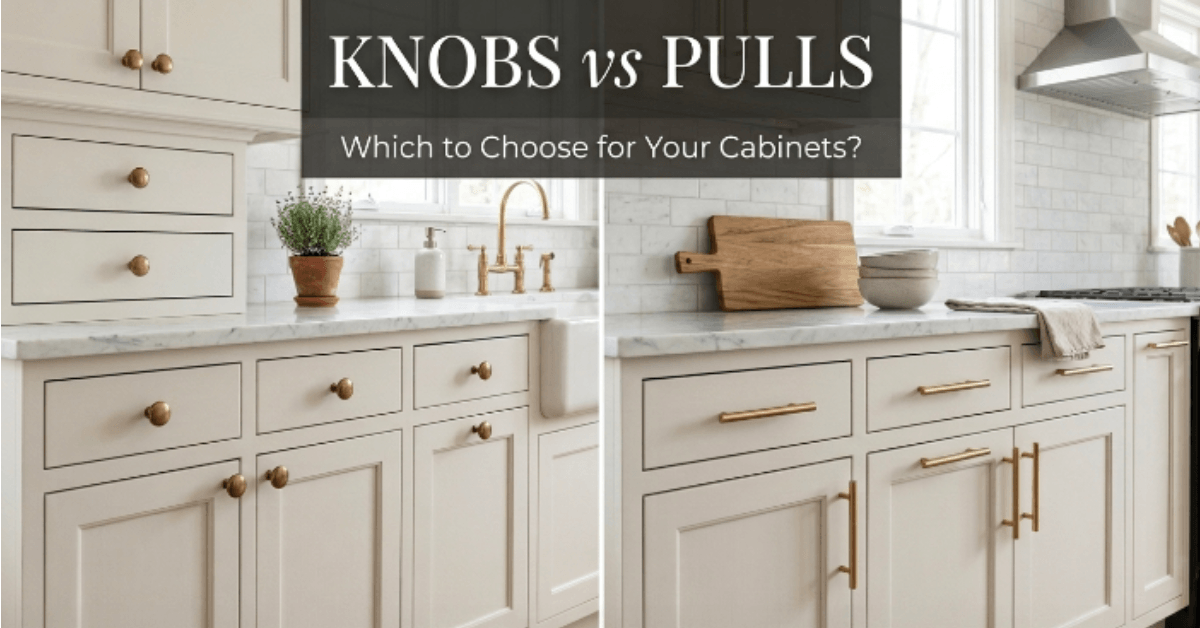
Standing in the hardware aisle, staring at forty near-identical choices, suddenly knobs vs pulls on cabinets seems trickier than it needs to be. The thing is, this stuff is for your hands, so you’re touching it dozens of times a day for years. Getting it right matters more than most folks think before they’ve actually lived with the wrong pick. Below is kind of a straightforward look at how each type plays out, where each one really works best, and how to choose the right option for your kitchen.
Cabinet Knobs: The Basics
A cabinet knob is sort of single-point hardware you grab with your fingertips, not your whole hand. It can be round, square, or a little more sculptural, and it mounts with just one screw, plus it barely registers at all on the door face. That’s one of the main reasons it’s stuck around so long. They tend to feel quieter and more traditional, and if you change finishes later, replacing them is usually not too expensive.
Knobs make the most sense on upper cabinet doors and smaller drawers, where a long pull would feel oversized. Cabinet construction matters here too, since frameless cabinets vs framed cabinets can change the visible door layout and how prominent the hardware feels across a full kitchen. Knobs also tend to be the cheaper option, since you’re buying one small piece rather than a longer bar.
Cabinet Pulls: The Basics
Pulls, sometimes called handles, run longer and need two screws instead of one. Because you’re gripping with your whole hand rather than a pinch of fingers, pulls make a real difference on heavy doors and drawers you open constantly. They’ve become the standard in a lot of newer kitchen builds, especially on lower cabinets and deep drawer stacks, mostly because there’s simply more to hold onto.
Picture your busiest drawer, the one with silverware or pots or the trash pull-out. That’s where a pull does its best work. Pinching a small knob over and over throughout the day gets old fast, and that has less to do with style and more to do with how your hand actually moves through the space.
Cabinet Knobs Vs Pulls: A Side-by-Side Look
| Factor | Cabinet Knobs | Cabinet Pulls |
| Grip style | Fingertip grab | Full-hand grip |
| Best for | Upper cabinets, small drawers | Lower cabinets, heavy drawers |
| Look | Traditional, understated | Modern, substantial |
| Cost | Cheaper per piece | Slightly more per piece |
| Mounting | One screw | Two screws |
| Daily comfort | Fine for light use | Better for frequent use |
Some quick takeaways from that:
- Knobs stretch your budget further across a whole kitchen
- Pulls are more comfortable anywhere you’re reaching often, like a trash drawer
- Combining the two is common practice, not a design slip
- Finish matters just as much as shape, since matte black, brass, and nickel each read differently against different cabinet colors
- Size needs to match the door or drawer it’s on, not just follow a matching set out of habit
Scale is where most people trip up. A tiny knob on a wide pantry door looks lost, and an oversized pull on a slim drawer front throws the whole thing off balance. Designers point to hardware proportion as the single most common mistake homeowners make, ahead of color or finish decisions.
Choosing Cabinet Hardware for Doors vs Drawers
A lot of the confusion here comes from assuming the whole kitchen has to match. Doors and drawers genuinely don’t need the same hardware.
For cabinet doors, knobs usually make more sense. You’re opening them occasionally, and the motion is more of a swing than a pull. This holds especially true for upper cabinets, where a long pull mounted at eye level or above can feel heavy and out of proportion.
For drawers, pulls tend to be the better call, particularly anything wider than about 18 inches. A single centered knob on a wide drawer forces you to reach to one side every time you open it. A pull spans more of the front, distributes the force evenly, and just feels more natural in the hand.
Mixing Hardware Styles in One Kitchen
A lot of well-designed kitchens don’t pick just one. The most common approach pairs knobs on the upper doors with pulls on lower cabinets and drawers, and it’s not purely a style call either. It matches the hardware to how each zone gets used day to day. You reach up and twist for the uppers. You pull straight out for the drawers.
What separates a mix that looks planned from one that looks accidental usually comes down to finish consistency. Matte black knobs paired with brass pulls in the same kitchen tend to read as unfinished or mismatched. Matte black knobs alongside matte black pulls in a slightly different shape read as intentional instead. Even small details in the metalwork can change the overall character of a kitchen cabinet hardware as part of the larger design decision rather than something tacked on at the end.
A Few Things to Check Before You Order
- Match the scale to the piece. Standard drawers typically suit 3 to 4 inch pulls, while wider drawers can carry 6 to 12 inches or more
- Factor in frequency of use. High-traffic drawers benefit from pulls, occasional-use doors do fine with knobs
- Test before committing. Hold the hardware against your actual cabinet color and the light in your kitchen, not just how it looks in a product photo
- Stick with one finish family. Brushed nickel, matte black, and brass all pair fine with different shapes as long as the metal tone stays consistent throughout the room
Door style matters just as much when choosing hardware. Different cabinet door design trends change how much visual attention a knob or pull gets, since a simple flat front handles hardware very differently from a more detailed raised panel door.
The Bottom Line
There’s no single correct answer between knobs vs pulls on cabinets. Both perform well long-term, and the smarter choice comes down to which cabinets you’re outfitting and how your household actually uses the kitchen. Many homeowners also consult a custom cabinet maker to choose hardware that complements their cabinetry style and daily needs. Knobs are affordable, classic, and suited to lighter use. Pulls handle frequent, heavy use better and tend to suit larger or more contemporary spaces. Many of the best kitchens use a mix of both, matched thoughtfully to function rather than chosen for looks alone. Nail the scale and keep the finish consistent, and whichever direction you go will feel like it belongs.
Frequently Asked Questions
Are knobs or pulls better for kitchen cabinets?
It really depends on the cabinet rather than one option being universally better. Knobs work well on doors and lighter-use spots, while pulls handle drawers and frequent use more comfortably. Many kitchens end up using both.
Should I use knobs or pulls on drawers?
Pulls tend to work better, especially on drawers wider than about 18 inches. A single knob centered on a wide drawer means you’re always reaching off to one side, while a pull spreads across more of the front and opens more naturally.
Can you mix knobs and pulls in the same kitchen?
Definitely, and it’s a common approach. Knobs on upper doors paired with pulls on lower cabinets and drawers is the most popular combination. The key is keeping the finish consistent so the mix reads as a choice rather than a mismatch.
Are cabinet pulls more modern than knobs?
Pulls do show up more frequently in modern and transitional kitchens, particularly sleek bar-style versions. That said, knobs can absolutely work in a modern space too, as long as the shape and finish fit the rest of the design.
Which option is easier to clean?
Knobs have a slight edge here since there’s less surface for grease and fingerprints to accumulate on. Pulls collect a bit more grime along the bar, though neither takes much effort to wipe down during regular kitchen cleaning.
What size cabinet pulls should I choose?
Standard drawers generally suit 3 to 4 inch pulls, while wider drawers and larger cabinets can handle 6 to 12 inches or longer. The general rule is proportion: the pull should feel sized to what it’s mounted on, not just match a set length across every cabinet in the kitchen.