Have you ever opened a kitchen cabinet and had three pans fall forward? Or tried to store a vacuum in a closet that’s just a few inches too narrow? These problems happen when cabinets look good but don’t match the way you live.
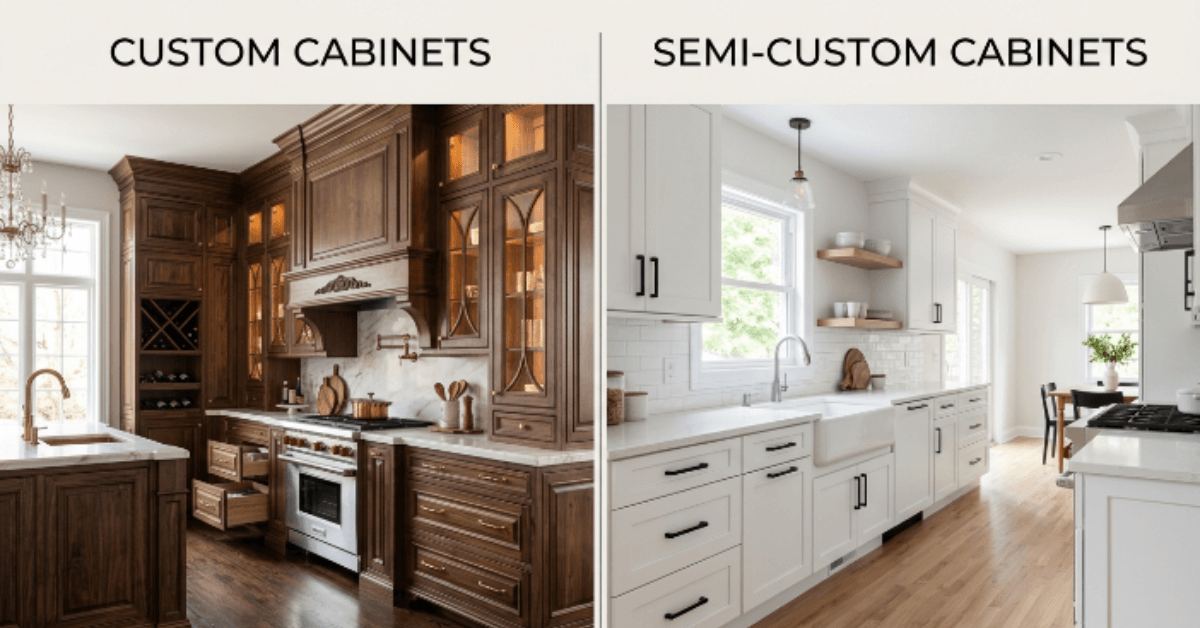
That’s why the choice between custom vs semi-custom cabinets matters. Semi-custom cabinets give you useful design choices at a more manageable price. Custom cabinets are made for your exact space, storage needs, and daily routine.
The real goal isn’t simply buying cabinets. It’s creating storage that makes your kitchen, garage, and other rooms easier to use.
Custom vs Semi Custom Cabinets: Quick Comparison
| Daily problem with ready-made cabinets | How custom cabinets make life easier |
| Standard sizes leave awkward gaps beside walls and appliances. | Custom cabinets fit the exact space and turn unused gaps into practical storage. |
| Shelves are too short for large pots, mixers, or storage boxes. | Shelf height and depth can be planned around the items you actually own. |
| Deep cabinets make items at the back difficult to reach. | Pull-out shelves and deep drawers bring everything into view. |
| Corner cabinets become dark spaces where items get lost. | Corner pull-outs or rotating shelves make the whole area easy to use. |
| Kitchen bins take up floor space or block walkways. | Built-in pull-out bins keep rubbish hidden and free up floor space. |
| Small appliances make the kitchen worktop feel crowded. | An appliance garage stores the toaster, blender, or coffee machine in one neat place. |
| Garage tools and sports equipment end up on the floor. | Strong drawers, tall cupboards, and wall cabinets keep the garage safe and organised. |
| Bathroom products cover the sink and worktop. | Shallow drawers and fitted vanity storage give every item a proper place. |
| Laundry products sit on top of the washing machine. | Cabinets can be fitted above or beside the machines for detergents, baskets, and cleaning supplies. |
| Wardrobes waste space above hanging clothes. | Floor-to-ceiling cabinets use the full height of the room. |
| Office cables, paperwork, and equipment remain visible. | Built-in desk cabinets can hide cables, files, printers, and charging equipment. |
| Cabinet doors hit walls, appliances, or nearby handles. | Door sizes, hinges, fillers, and opening directions are planned for the exact room. |
| Ready-made units don’t fit around pipes, beams, or sloped ceilings. | Custom cabinetry can be shaped around difficult features without leaving large gaps. |
| The cabinets look separate from the rest of the room. | Matching colours, finishes, trim, and hardware create a smooth, built-in appearance. |
Neither option is automatically better. Your choice depends on your room, budget, timeline, and how much cabinet customization you need.
What Are Custom Cabinets?
Custom cabinets are designed and built for a specific room.
Instead of choosing from fixed sizes, you can decide the exact:
- Height
- Width
- Depth
- Door style
- Wood type
- Colour
- Finish
- Hardware
- Interior storage
- Cabinet layout
This makes custom cabinets useful in rooms with sloped ceilings, uneven walls, tight corners, or strange gaps.
Imagine having an empty space beside the fridge that collects dust. With custom cabinetry, that narrow gap could become a pull-out spice rack, tray holder, or broom cupboard.
That’s the main benefit of custom work: wasted space can become useful storage.
What Are Semi-Custom Cabinets?
Semi-custom cabinets start with standard cabinet sizes and designs. You can then make selected changes from the manufacturer’s available options.
Depending on the cabinet line, you may be able to change:
- Cabinet width or depth
- Door style
- Paint or stain
- Hardware
- Drawer type
- Shelving
- Decorative trim
- Storage inserts
You get more choice than you would with stock cabinets, but you don’t have complete freedom.
For example, you may be able to reduce a cabinet’s depth by a few inches. However, you may not be able to create a completely new shape.
Semi-custom works well when your room has a fairly normal layout, but you still want it to feel personal.
Why Customization Is the Key to Better Cabinets
A seamless room isn’t only about doors that line up neatly. It’s also about making sure everything has a proper place.
Good cabinet customization starts with your daily problems.
Ask yourself:
- Where do bags and coats pile up?
- Which kitchen tools are hard to reach?
- Where do cleaning products sit?
- Do bins block the walkway?
- Is the garage floor covered with tools?
- Do bathroom products crowd the worktop?
- Is office paperwork always left on the desk?
These problems show you what the cabinets need to do.
A pull-out bin can clear the kitchen floor. Deep drawers can stop pans from being stacked in a tall, wobbly pile. Tall garage cabinets can hide tools, paint, and sports gear.
When storage is planned around real life, the whole room feels calmer.
Design Flexibility
When it comes to flexibility, custom cabinets offer the most freedom.
A cabinet maker can create units around:
- Pipes
- Beams
- Windows
- Appliances
- Sloped ceilings
- Uneven walls
- Tight corners
- Unusual room shapes
This helps the cabinets look built into the room instead of added as an afterthought.
Semi-custom cabinets still offer plenty of choice. You may be able to change the finish, door, hardware, size, and storage features. However, every change must stay within the brand’s set options.
When comparing custom vs semi-custom cabinets, think about how unusual your room is. A standard room may not need fully custom work. An awkward room may benefit from exact measurements.
Custom Cabinets in the Kitchen
The kitchen is where smart planning makes the biggest everyday difference.
Instead of filling every wall with basic shelves, custom cabinets can include:
- Deep drawers for pots
- Tray dividers
- Pull-out spice storage
- Hidden bins
- Appliance garages
- Corner pull-outs
- Vertical storage for chopping boards
- A tall pantry
- A coffee station
- A pet-feeding area
- Charging drawers
- Built-in seating
Think about your morning routine. If you make coffee every day, keeping the machine, mugs, pods, and sugar in one cabinet can save time.
If you cook often, wide drawers near the stove can hold pots and pans. You won’t need to kneel on the floor and dig through a dark cabinet.
Customization turns the kitchen into a space that works with you, not against you.
Cabinets in the Garage
The garage often becomes the place where unwanted items go to hide.
Tools end up on the floor. Sports gear gets thrown into corners. Paint tins sit beside cleaning products. Before long, there’s hardly enough room for the car.
Custom or semi-custom garage cabinets can provide:
- Tall storage for garden tools
- Lockable cupboards for chemicals
- Drawers for small tools
- Wall cabinets above a workbench
- Open sections for sports gear
- Shelves for storage boxes
- Shoe and boot storage
- A charging space for tools
In a garage, cabinet customization should focus on strength and safety as well as appearance.
Cabinets may need to handle heavy items, dust, moisture, and temperature changes. The materials and finish should suit those conditions.
Custom cabinets can be built around meters, pipes, windows, or a garage door track. Semi-custom units may work well in a simple, straight garage layout.
Cabinets in Living Rooms and Bedrooms
Custom cabinetry isn’t limited to kitchens. It can also solve everyday storage problems in living rooms, adult bedrooms, and children’s rooms.
In a living room, cabinets can be fitted around a television, fireplace, or window. Built-in drawers and cupboards can hide cables, gaming equipment, books, toys, blankets, and remote controls. This keeps the room tidy without filling it with extra furniture.
In an adult bedroom, customized cabinets can include:
- Floor-to-ceiling wardrobes
- Shoe drawers
- Jewellery trays
- Bedside cabinets
- Window seats with hidden storage
- Pull-out laundry baskets
- Cabinets above or around the bed
If the bedroom is small, fitted cabinets can use the full height of the wall. This creates more storage while leaving valuable floor space open.
Cabinets for a Boy’s Room
A boy’s room may need strong, easy-to-use storage for clothes, shoes, school supplies, sports gear, toys, or gaming equipment.
Custom options can include:
- Deep drawers for toys
- Open shelves for books and trophies
- Tall storage for bats or sports equipment
- A built-in desk for homework
- Hidden spaces for gaming wires
- Cabinets around the bed
- Labelled sections for school and sports items
As the child grows, adjustable shelves can be moved to hold larger clothes, books, or equipment.
Cabinets for a Girl’s Room
A girl’s room may need storage for clothes, shoes, books, craft supplies, toys, accessories, or school items.
Useful options may include:
- A wardrobe with adjustable hanging rails
- Small drawers for hair accessories or jewellery
- Shoe shelves
- A built-in desk for homework or crafts
- Open shelves for books and favourite items
- A window seat with storage underneath
- A hidden laundry basket
- Cabinets around a mirror or dressing area
The best design should follow the child’s interests rather than fixed rules about boys’ and girls’ rooms. A child who loves art may need craft drawers, while a child who plays sports may need tall equipment storage.
Semi-custom cabinets can also work well for wardrobes and media units, especially when the walls are straight and the room has standard measurements. However, custom cabinets are more useful when you need to fit around a window, bed, sloped ceiling, or unusual corner.
Cabinets in Bathrooms and Laundry Rooms
Bathroom worktops quickly become crowded with bottles, towels, hair tools, and toiletries.
Customized cabinets can include shallow drawers for small items, tall storage for towels, and pull-outs for cleaning products.
In a laundry room, cabinets can be built above or beside the machines. You can add:
- A folding counter
- Laundry baskets
- Hanging space
- Detergent storage
- A pull-out ironing board
- A tall cupboard for the vacuum
- Storage for pet supplies
These details may sound small, but they solve problems you deal with every day.
That’s why good cabinets aren’t only about style. They’re about making the room easier to use.
Cabinet Construction and Door Choices
Both custom and semi-custom cabinets can offer different construction styles.
For example, inset doors sit inside the cabinet frame and create a flush, furniture-like look. They require very exact construction because the gaps around each door must stay even.
Overlay doors sit over the frame. They’re usually easier to install and may provide slightly easier access to the cabinet opening.
Inset cabinets can look seamless, but they may cost more and need small adjustments if wood moves due to heat or humidity.
With full custom work, you can usually choose from more construction methods, hinges, finishes, and door details. Semi-custom lines provide a set menu of choices.
The right construction should match the room. A detailed inset design may be worth it in a main kitchen, while a simple overlay cabinet may make more sense in a busy garage or laundry room.
Custom vs Semi Custom Cabinets: Cost
A cabinet cost comparison isn’t as simple as one set price.
Custom cabinets usually cost more because they involve:
- Individual design work
- Exact measurements
- More labour
- Special sizes
- Skilled building
- Custom finishes
- Detailed installation
Semi-custom cabinets are more affordable because the main cabinet parts are based on standard sizes and production methods.
However, the cheapest option isn’t always the best value.
Suppose semi-custom cabinets leave a large filler panel beside a wall. You may save money, but you may lose storage space. A custom cabinet could use that same space for trays, bottles, or cleaning tools.
On the other hand, paying for fully custom cabinets on a simple wall may not give you much extra benefit.
Spend custom money where it solves a real problem. Use semi-custom units where standard sizes work well.
Can You Mix Custom and Semi-Custom Cabinets?
Yes. A mixed approach can give you the best of both worlds.
You might use semi-custom cabinets for the main kitchen walls, then add custom pieces for:
- An unusual corner
- A fitted pantry
- A kitchen island
- A coffee bar
- A window seat
- A narrow pull-out
- A built-in fridge surround
The same idea can work in other rooms. Use standard semi-custom cabinets along a garage wall, then build one custom tall unit around pipes or tools.
This approach keeps the room looking connected while controlling the budget.
Make sure the door style, colour, finish, and hardware match. Small differences can stand out when cabinets sit beside each other.
How Long Do Cabinets Take to Build?
Semi-custom cabinets are normally faster because the manufacturer already has standard designs and production methods.
A typical semi-custom order may take several weeks. Custom work can take a few months, especially when the design is detailed or the cabinet maker is busy.
Timelines can change based on:
- Project size
- Materials
- Finish
- Hardware
- Design changes
- Manufacturer workload
- Delivery
- Installation
Don’t remove your current cabinets until the new order and installation schedule are confirmed.
Living without a working kitchen is hard. A clear timeline can save you from weeks of takeaway meals and washing dishes in the bathroom sink.
Do Custom Cabinets Increase Home Value?
Well-made custom cabinets may improve the way buyers see a home.
Built-in storage can make rooms feel organised, finished, and easier to use. A fitted pantry, clean media unit, or tidy garage system may also help the home stand out.
However, custom cabinets don’t guarantee a set increase in property value.
Value also depends on:
- Build quality
- Condition
- Materials
- Design
- Storage
- Installation
- Local buyer demand
- The overall room
Very personal designs may not appeal to everyone. Bright colours or highly unusual layouts could make resale harder.
For wider appeal, use durable materials, practical storage, and a style that suits the home.
Common Mistakes to Avoid
Copying a showroom
A showroom may look beautiful, but it doesn’t know where you keep your air fryer or how many lunch boxes your family uses.
Plan around your belongings and routine.
Forgetting door clearance
Check whether doors and drawers will hit walls, appliances, or each other.
Ignoring future needs
Think about children, pets, ageing, new appliances, hobbies, and working from home.
Choosing looks over storage
A clean front is lovely, but the inside must also work.
Not measuring large items
Measure mixers, pans, tools, bins, printers, and storage boxes before choosing cabinet sizes.
Over-customizing every inch
Not every cabinet needs a special feature. Too many add-ons can raise the cost without making the room more useful.
Frequently Asked Questions
What are custom cabinets?
Custom cabinets are designed and built to fit a specific room, layout, and storage need. Their size, material, finish, style, and internal features can be selected.
What are semi-custom cabinets?
Semi-custom cabinets use standard designs and sizes but allow selected changes, such as finishes, door styles, dimensions, and storage features.
Are custom cabinets worth the extra cost?
They can be when you have an unusual room, need special storage, or want a seamless built-in result. They may not be necessary for a simple layout.
How long does it take to build custom cabinets?
Custom cabinets often take several weeks to a few months. The exact time depends on the project, cabinet maker, materials, and finish.
Which option offers more design flexibility?
Custom cabinets offer the most flexibility. Semi-custom cabinets provide a good choice but stay within the manufacturer’s available options.
Do custom cabinets increase home value?
They may improve buyer appeal when they’re well made, practical, and suited to the home. However, an increase in value isn’t guaranteed.
Final Thoughts
The custom vs semi-custom cabinets decision isn’t only about price. It’s about how well the cabinets fit your room and your life.
Start with the problems you deal with every day. Then choose the cabinet option that solves them without wasting space or money. That’s how you create storage that looks good and genuinely makes life easier.