Your kitchen cabinets may still work perfectly, but the wide gaps around the doors can make the whole room feel old. Or perhaps you’re planning a remodel and can’t decide which door fitting will give you a cleaner look without pushing up the cost.
That’s where full overlay cabinets vs partial overlay comes in. Full overlay doors hide most of the cabinet frame, giving your kitchen a smooth, updated appearance. Partial overlay doors leave more of the frame visible but are often simpler and more budget-friendly. Understanding this small difference can help you choose cabinets that suit your space, style, and daily routine.
Let’s explore and find out what you need to know before you choose.
Full Overlay Cabinets vs Partial Overlay: Quick Comparison
| Feature | Full overlay | Partial overlay |
| Frame visibility | Very little frame shows | More frame remains visible |
| Overall look | Clean and modern | Classic and relaxed |
| Door size | Larger | Smaller |
| Cost | Often slightly higher | Usually more affordable |
| Installation | Needs careful fitting | More forgiving |
| Cleaning | Fewer exposed frame areas | More visible frame to wipe |
| Best for | Modern and updated kitchens | Traditional and budget-friendly kitchens |
Both options use doors that sit on top of the cabinet frame. The main difference is how much of that frame they cover.
What Are Cabinet Overlays?
Before comparing the two styles, it helps to understand what an overlay is.
Most framed cabinets have a wooden frame attached to the front of the cabinet box. The doors and drawers are fitted over this frame.
Kitchen cabinet overlays describe how much of the frame is covered by the doors and drawer fronts.
There are two common choices:
- Full overlay
- Partial overlay
Inset cabinets are different. Their doors sit inside the frame instead of resting on top of it.
Overlay doors are popular because they’re easier to make and install than inset doors. They also work with many cabinets’ door styles, including Shaker, slab, recessed-panel, and raised-panel doors.
What Are Full Overlay Cabinets?
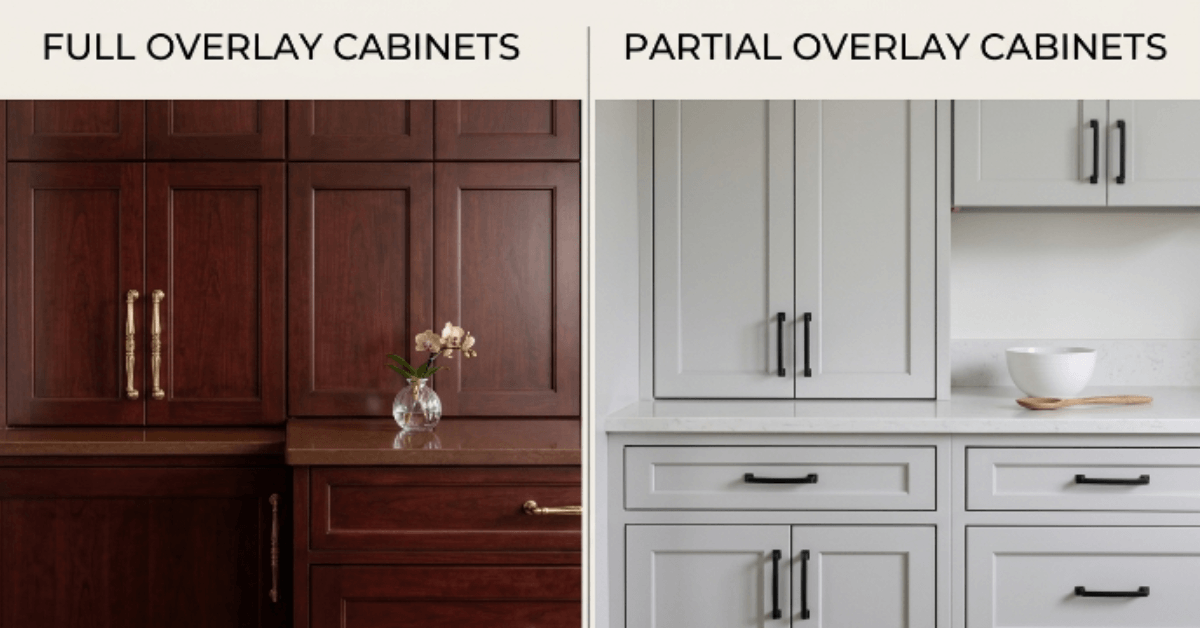
Full overlay cabinets have larger doors and drawer fronts that cover most of the cabinet’s face frame.
When the doors are closed, only small gaps can be seen between them. This creates a smooth, even look.
The frame isn’t always completely hidden. A small part may still be visible around the edges or between some doors. However, it’s far less noticeable than it is with partial overlay cabinets.
Full overlay works well if you want:
- A clean appearance
- A modern kitchen
- Less visible cabinet framing
- Larger-looking doors
- A style similar to frameless cabinets
Many homeowners choose full overlay because it can update the kitchen without using expensive inset cabinets.
What Are Partial Overlay Cabinets?
Partial overlay cabinets use smaller doors and drawer fronts. These cover only part of the face frame, leaving larger gaps between each door and drawer.
You may also hear this style called standard overlay or traditional overlay.
Partial overlay was common in many older kitchens. It still works well in traditional, country, rental, and budget-friendly spaces.
This option may suit you if you want:
- A classic cabinet look
- Lower costs
- Easier installation
- More space between doors
- A simple kitchen update
- Less worry about exact door alignment
Partial overlay isn’t automatically outdated. The colour, handles, worktop, and door design all affect the final look.
A simple Shaker door with fresh paint can make partial overlay cabinets feel warm and welcoming rather than old.
The Main Difference Between Full and Partial Overlay
The biggest difference is easy to see: full overlay hides most of the frame, while partial overlay leaves more of it visible.
Think of the cabinet frame like a picture frame.
With full overlay, the cabinet doors are like large pictures that cover most of the frame. With partial overlay, the pictures are smaller, so more of the frame remains on show.
When comparing full overlay cabinets vs partial overlay, this affects four main things:
- Appearance
- Cleaning
- Cost
- Installation
The cabinet boxes may be very similar underneath. It’s the size and position of the doors that create the different look.
Which Style Looks More Modern?
Full overlay usually looks more modern.
The doors sit close together, creating smooth lines across the kitchen. There are fewer strips of frame breaking up the design.
This clean look works well with:
- Slab doors
- Narrow Shaker doors
- Simple handles
- Hidden hinges
- Light wood finishes
- White, black, navy, or green paint
- Plain worktops
Partial overlay has a more traditional appearance because the visible frame creates clear borders around every door and drawer.
However, the door style matters too. Full-overlay raised-panel doors may still look traditional. Partial-overlay slab doors can feel simpler and more modern.
Overlay is only one part of the overall design.
Which Is Easier to Keep Clean?
Kitchen cabinets collect more dirt than we like to admit.
Greasy hands, cooking steam, dust, food splashes, and fingerprints can all leave marks. If you have young children, you may feel like you’re wiping cabinet doors every day.
Full overlay may be a little easier to clean because less of the frame is exposed. The doors cover most of the front, giving you fewer separate edges to wipe.
With partial overlay cabinets, dust and grease may gather on the visible frame around the doors. This doesn’t make them difficult to clean, but there are more surfaces to check.
The actual door design also matters. Flat doors are easier to wipe than doors with deep grooves or raised details.
If easy cleaning is your main goal, choose a simple door with a washable finish.
Do Full Overlay Cabinets Offer More Storage?
Not necessarily.
When comparing full and partial overlay cabinets built with the same cabinet box and face frame, the inside storage space is usually very similar. The overlay mainly changes the door size and how much frame you can see.
Full overlay doors may create the feeling of a larger opening because the doors themselves are wider. However, the face frame behind them can still limit access.
Frameless cabinets normally provide more open access because they don’t have a front face frame. Inset cabinets may provide slightly less usable space because their doors sit inside the frame.
If storage is a daily struggle, don’t choose based on overlay alone. Also check:
- Interior cabinet width
- Shelf depth
- Drawer size
- Door opening angle
- Pull-out storage
- Corner cabinet access
- Adjustable shelving
Bring your largest pots, plates, or food containers into the plan. A beautiful cabinet won’t help if your baking tray still doesn’t fit.
Are Full Overlay Cabinets More Expensive?
Full overlay cabinets can cost slightly more than partial overlay cabinets.
The doors and drawer fronts are larger, so they may use more material. They also need careful sizing and fitting to create small, even gaps.
If the doors aren’t lined up correctly, the problem is easy to notice. Hinges may need more adjustment during and after installation.
Partial overlay doors are smaller and have wider spaces around them. This makes small alignment differences less obvious and can make installation easier.
However, overlay isn’t the only thing that affects the cost. Your final price also depends on:
- Cabinet material
- Door design
- Paint or stain
- Hardware
- Custom sizing
- Cabinet brand
- Soft-close hinges
- Installation costs
Custom hardwood partial overlay cabinets may cost far more than ready-made full overlay cabinets.
Always compare complete quotes rather than assuming one style will be cheaper.
Which Style Is Easier to Install?
Partial overlay is usually more forgiving.
The larger gaps between doors allow a little room for small fitting differences. This can make partial overlay a practical option for DIY projects and budget kitchens.
Full overlay requires better planning. Since the doors sit close together, poor measurements may cause them to rub or hit each other.
Problems often happen:
- Where two corner cabinets meet
- Beside a wall
- Near an appliance
- Around deep handles
- When doors open in opposite directions
You don’t want to install your new kitchen and then find that two doors can’t open at the same time.
Before ordering overlay cabinet doors, check the space needed for hinges, handles, walls, appliances, and nearby drawers. A filler strip may be needed beside a wall or in a corner.
When in doubt, ask an experienced cabinet installer to check the measurements.
Which Is Better for a Small Kitchen?
Full overlay is often a good choice for a small kitchen.
Because less frame is visible, the cabinets create a smoother surface. This can make the room feel less busy.
Light-coloured full overlay doors can also help a small kitchen look brighter and more open.
But there’s a catch. Full overlay doors are larger and sit closer together. In a tight corner, they may bump into nearby doors, handles, walls, or appliances.
Partial overlay leaves more room between doors. This may make it easier to use in a kitchen with awkward corners or uneven walls.
So, don’t choose only with your eyes. Think about how you move around the kitchen every day.
Can the fridge open fully? Will the corner drawer hit the oven handle? Can two people use nearby cabinets at once?
Good design should make daily life easier, not create a new problem.
Can You Change Partial Overlay to Full Overlay?
Sometimes, yes.
If your cabinet boxes and frames are in good condition, you may be able to replace partial overlay doors with full overlay ones.
However, it isn’t always as simple as buying larger doors.
You’ll need to check:
- Door and drawer measurements
- Hinge type
- Available frame space
- Gaps between doors
- Corner clearances
- Appliance clearances
- Handle position
New hinges will often be required. The doors must also be measured carefully so they don’t overlap or rub.
Refacing can be cheaper than replacing the full cabinets, but poor measurements can turn a simple job into an expensive headache.
Frequently Asked Questions
What are full overlay cabinets?
Full overlay cabinets have doors and drawer fronts that cover most of the cabinet’s face frame. Only small gaps remain visible.
What are partial overlay cabinets?
Partial overlay cabinets have smaller doors that leave more of the face frame visible around each door and drawer.
Which cabinet style looks more modern?
Full overlay generally looks more modern because the doors sit closer together and hide most of the frame.
Are full overlay cabinets more expensive?
They may cost slightly more because the doors are larger and need more careful fitting. Material, finish, hardware, and installation also affect the price.
Do full overlay cabinets offer more storage space?
Not always. If both styles use the same cabinet box and face frame, their inside storage is usually similar. Frameless cabinets may offer easier access and more usable space.
Which overlay style is best for my kitchen?
Choose full overlay for a clean, modern look. Choose partial overlay for a classic appearance, easier fitting, and a lower possible cost.
Final Thoughts
The full overlay cabinets vs partial overlay choice is mostly about the look you want and the way your kitchen works.
Full overlay hides most of the frame and gives the room a smooth, modern finish. Partial overlay shows more of the frame and offers a classic, practical look. If you’re planning a personalized upgrade, custom cabinetry services can help you choose the overlay style that best matches your layout, storage needs, and design preferences.
Before deciding, think about more than a showroom photo. Check your budget, cleaning habits, corner spaces, appliances, storage needs, and installation plan.
After all, cabinet doors are opened and closed every day. The best style shouldn’t only look good; it should make your kitchen easier to live with.