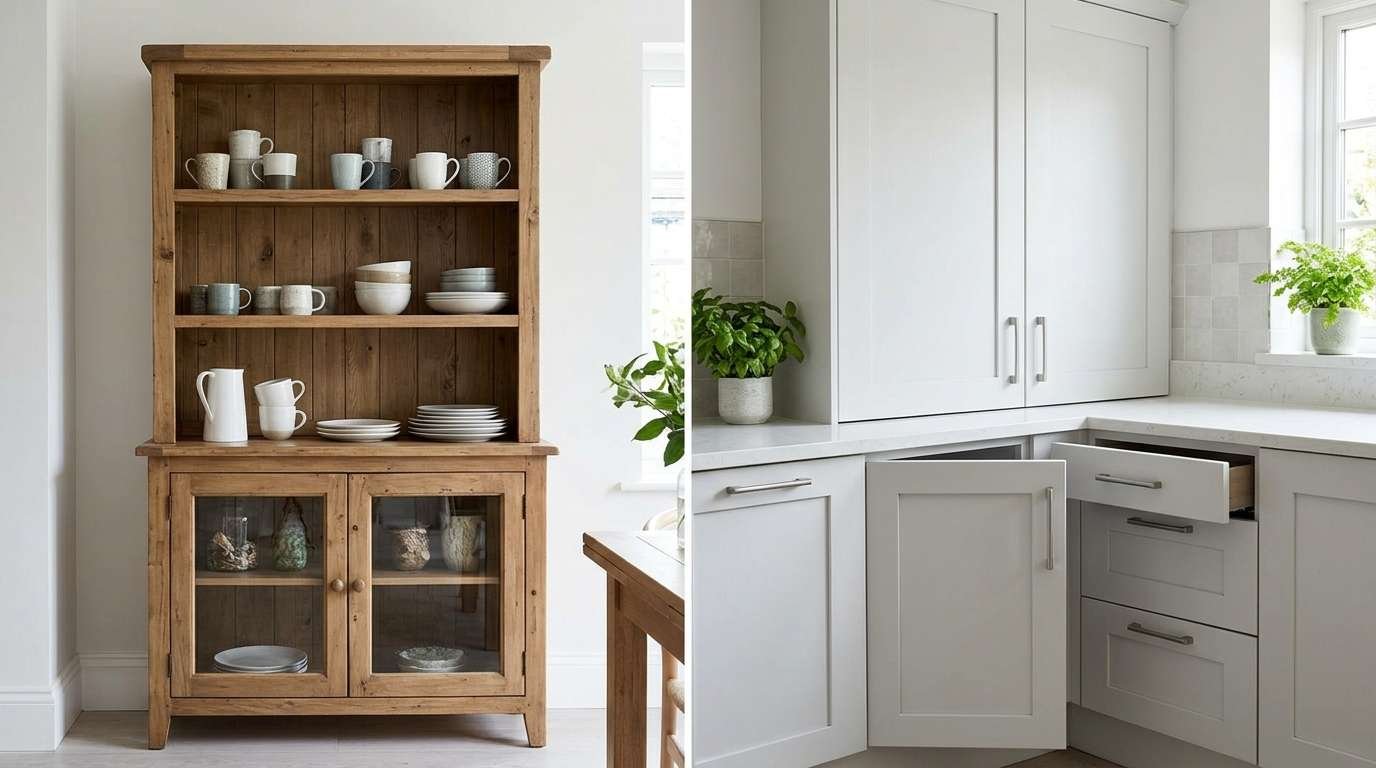
People tend to struggle when they attempt to answer this question. The actual distinction between a cupboard and a cabinet remains unknown to most people. Most people start answering and then stop halfway through because they realize they are not totally sure. The two words get thrown around like they mean the same thing. The two words share meaning at some times yet differ in their usage at other times.
The kitchen remodel planning process and the contractor communication require you to understand this information because getting it wrong creates both minor inconveniences and major financial losses. The explanation uses basic language to present both concepts while showing their distinct characteristics and their appropriate usage situations.
What Is a Cupboard?
So what is a cupboard? The cupboard definition is simple. It is an enclosed piece of furniture with doors and shelves. That is the core of it.
The word comes from “cup board,” which was literally just a flat board where cups sat. Over time, it became a catch-all term for enclosed storage in a home.
Cupboards are simple by nature. Doors, shelves, storage. Most have no drawers. No fancy hardware beyond a basic hinge. They are not part of a bigger system. They just store things.
They can be freestanding or built directly into a wall. A built-in cupboard sits flush with the wall. A freestanding one stands alone, and you can move it.
Common examples include pantry cupboards, linen cupboards, hutches, wardrobes, armoires, and under-stair cupboards. The cupboard meaning in everyday speech is broad and depends a lot on where you grew up.
What Is a Cabinet?
What is a cabinet? The cabinet definition is tighter.
It is a built storage unit designed for a specific room and purpose. Kitchen cabinets, vanity cabinets, base cabinets, wall cabinets, tall cabinets. These get installed as part of a coordinated layout, not placed around a room individually.
The construction is where it really differs from a cupboard. A kitchen cabinet has a cabinet box, a face frame, a cabinet door, soft-close hinges, and drawer slides. Better builds use dovetail joinery in the drawer boxes because that holds up under years of daily use.
Materials range from solid hardwood like oak, maple, cherry, walnut, and hickory in quality builds, to plywood for cabinet boxes, to MDF, particleboard, veneer, and laminate at lower price points.
A pantry cabinet built from solid hardwood with a face frame is a completely different product from a basic freestanding cupboard. Both store things. That is about where it ends.
Why People Get These Two Mixed Up
Honestly it is mostly a geography thing.
In the US, cabinet is the word people use. Kitchen cabinets, bathroom cabinets, garage cabinets. Nobody really says cupboard in everyday American conversation unless they are talking about something freestanding or they grew up somewhere else.
In the UK and Australia it flips. What Americans call a kitchen cabinet, British people call a kitchen cupboard. Same object. Totally different word. Neither is wrong.
So when people argue online about cupboard meaning vs cabinet meaning they are often just arguing about regional language habits more than anything else. The objects themselves overlap a lot.
And for anyone wondering what is a cupboard called in America, the answer is pretty much just cabinet. Knowing the types of cupboards helps clarify why the word covers so much ground.
The Real Differences Between Cupboard vs Cabinet
Okay here is where cupboard vs cabinet gets useful and practical.
Construction and hardware:
- Cabinets use specific hardware, soft-close hinges, drawer slides, and dovetail joinery in quality builds
- Cupboards keep it simple, basic hinges, and not much else
- A cabinet box is built to support countertops and take serious daily use over many years
- Cupboards handle lighter storage and do not carry that structural load
Function and placement:
- Cabinets are designed for specific rooms and follow standard sizing, so they work together as a layout
- Cupboards work as standalone storage in pretty much any room without needing to connect to a larger system
- Base cabinets and wall cabinets are sized to coordinate with each other
- Cupboards come in all kinds of sizes with no system behind them
Materials typically used:
- Custom cabinets use solid hardwood, high-grade plywood, and quality veneer
- Freestanding cupboards more often use MDF, particleboard, or laminate, especially at lower price points
- Better cupboards can use solid wood, but rarely match the build tolerances of custom cabinetry
Types of Cupboards You Will Actually Come Across
- Pantry cupboard: Stores food and kitchen goods. Can be freestanding or built-in.
- Linen cupboard: Usually in a hallway or bathroom. Towels, bedding, bathroom supplies.
- Built-in cupboard: Framed into a wall. Common in older homes where recessed storage fits naturally.
- Wardrobe or armoire: Freestanding clothing storage. Armoires are taller and more decorative, usually.
- Hutch: A two-piece unit with a base and an open or glass-fronted upper section. Dining rooms mostly.
- Under-stair cupboard: Built into the space beneath a staircase. Really practical use of otherwise wasted space.
Types of Cabinets
- Base cabinet: On the floor, it supports the countertop. The starting point of any kitchen layout.
- Wall cabinet: Mounts above the countertop. Every day storage for dishes and food.
- Tall cabinet: Floor to ceiling. Great for a pantry cabinet or utility storage.
- Vanity cabinet: Below a bathroom sink. Toiletries and cleaning supplies.
- Pantry cabinet: A tall, dedicated unit just for food. Freestanding or built-in.
- Blind corner base cabinet: Built specifically for kitchen corners where regular cabinets leave dead, unusable space.
The types of cabinets you choose depend entirely on the room and how the layout needs to work. Before committing to a bathroom layout, looking at real bathroom cabinet ideas first saves a lot of backtracking later.
The Corner Thing Nobody Talks About Enough
Corners in kitchens are genuinely a pain.
A basic cupboard pushed into a corner wastes most of the space inside it. You can reach whatever is right at the front. Everything behind that? Dead storage. It sits there untouched for months.
A properly designed blind corner base cabinet handles this differently. Pull-out shelves or swing-out hardware bring things forward so you can actually reach the back. That only exists in cabinetry. A standard cupboard just cannot do it, no matter how you position it.
Are Cupboards Cheaper?
Usually, yes for freestanding options at similar quality levels.
But it gets messy fast. A budget flat-pack kitchen cabinet can actually cost less than a solid wood freestanding cupboard. Price really depends on materials, size, and whether you are paying for professional installation on top of the unit itself.
Custom cabinetry costs the most upfront. No question about that. But it fits your exact space, uses quality materials throughout, and lasts for decades with normal care.
On Custom Cabinets and Long-Term Value
Working with the best cabinet maker in the United States means getting something built specifically for your home.
The doors line up. The cabinet box fits the wall perfectly. The hardware works smoothly years down the line. None of that happens with a generic cupboard you pulled off a showroom floor.
And at resale? Built-in cabinetry is part of the home and adds to its value. A freestanding cupboard is furniture. It leaves with you when you go.
Cupboard vs Cabinet: Which One Do You Actually Need?
Need something flexible you can move later or swap out without much hassle? A cupboard works fine for that.
Fitting out a kitchen or bathroom where storage needs to be permanent and built into the room? Cabinets are the right call, and there is not really a debate there.
The difference between a cabinet, a cupboard, and a closet is worth knowing too. A closet is a dedicated room or recessed space for clothing. A wardrobe is the freestanding version of that. Cabinet vs cupboard and cupboard or cabinet are questions that come down to one thing. How permanent do you need the storage to be?
Does What You Call It Actually Matter?
In casual conversation, not really. Everyone knows what you mean.
But when you are talking to a contractor or ordering from a supplier, it matters more than you think. Asking for a cupboard in a kitchen context might get you a freestanding piece when what you need is a built-in base cabinet. Small wording difference. Big difference in what shows up at your door.
To Wrap It Up
Cupboard vs cabinet is not a trick question. It just feels like one because the words overlap so much in everyday speech.
Cupboards are simple, flexible, and freestanding. Cabinets are precise, permanent, purpose-built. Both store things behind doors. But the construction, materials, hardware, and what they do for your home long term are genuinely different from each other.
Know which one you actually need before you start shopping. That single step saves more time and money than almost anything else in a storage or remodel project.
FAQs
Why do British people say cupboard and Americans say cabinet?
It is just regional language history. British English kept cupboard as the default word. American English shifted toward cabinet especially for built-in kitchen and bathroom storage. Same object, different word depending on where you grew up.
Are cupboards cheaper than cabinets?
For freestanding options at similar quality levels, usually yes. Custom cabinets cost more but they last longer and add real value to the home when you sell.
Do cabinets have drawers and cupboards don’t?
Not a hard rule but cabinets much more commonly include drawers as part of the design. Most basic cupboards are just doors and shelves with nothing else inside.
Which is better for resale value?
Cabinets, especially custom ones. Built-in cabinetry is part of the home and factors into its value. A freestanding cupboard is furniture and leaves with the seller.
Can I use a cupboard as a cabinet?
You can store the same things in both. But a freestanding cupboard will not fit a kitchen layout the same way and will not add the same long-term value to the room.