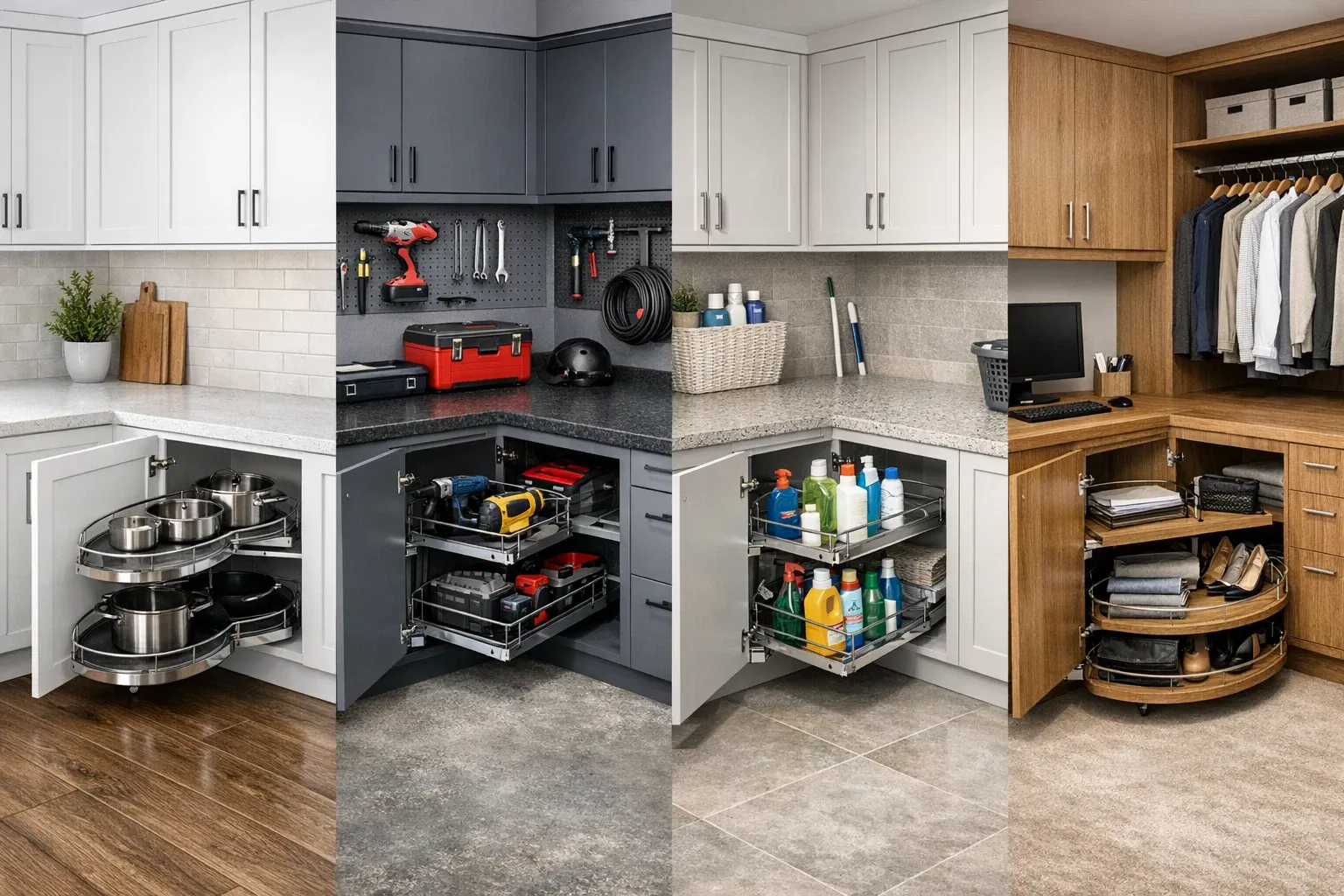
A kitchen corner can waste more space than you may think. When two rows of base cabinets meet, part of one cabinet can become hidden behind the other. This deep area is hard to see and even harder to reach.
A blind corner base cabinet solves this layout problem. It uses the corner for storage, even though part of the cabinet sits behind an adjoining unit. With the right shelves or pull-out system, the hidden area can become useful storage for pots, pans, appliances, and other kitchen items.
This guide explains what a blind corner cabinet is, how it works, its common sizes, costs, benefits, problems, and storage options.
What Is a Blind Corner Base Cabinet?
A blind corner base cabinet is a floor-mounted cabinet installed where two kitchen cabinet runs meet at a 90-degree angle. It is often used in an L-shaped or U-shaped kitchen layout to make use of corner space that might otherwise be wasted.
The cabinet has one visible door and an interior box that extends behind the cabinet on the adjoining wall. This hidden section is known as the “blind” area because it cannot be seen or reached directly from the front.
A blind base cabinet normally includes:
- One accessible cabinet opening
- A deep hidden storage area
- A wide frame or stile near the corner
- A filler strip that provides door and drawer clearance
- Fixed shelves, adjustable shelves, or a pull-out organizer
A basic unit may have only one shelf, which can make items at the back difficult to reach. More accessible designs use a Magic Corner, LeMans Pull-Out, Swing-Out Shelves, or another corner storage system to bring hidden items closer to the cabinet opening.
How Does a Blind Base Corner Kitchen Cabinet Work?
A blind base corner kitchen cabinet sits against one wall and extends into the corner. A second cabinet meets it from the adjoining wall.
The second cabinet covers part of the blind unit’s front. This creates the hidden storage area.
The blind cabinet cannot be pushed tightly into the corner without careful planning. It may need to be “pulled” away from the wall. A filler panel is also placed between the cabinet fronts.
This extra clearance helps:
- Doors open without hitting each other
- Drawers clear nearby handles
- Pull-out hardware moves correctly
- Cabinet fronts line up properly
- Appliances open without blocking the cabinet
Many installers use a filler of about 2 to 3 inches, but there is no correct size for every kitchen. The final measurement depends on the cabinet style, door overlay, handles, nearby appliances, and organizer hardware.
For example, a dishwasher handle may project farther than a cabinet knob. More clearance may be needed to stop a blind cabinet drawer from hitting it. This is why the full kitchen workflow must be planned before installation.
What Are Blind Corner Cabinets Used For?
The main purpose of a blind corner cabinet is space utilization. It creates storage inside a difficult kitchen corner.
Common uses include storing:
- Large pots and pans
- Mixing bowls
- Baking dishes
- Small appliances
- Food storage containers
- Serving trays
- Slow cookers
- Seasonal cookware
- Cleaning supplies
- Bulk pantry products
Items used every day should stay near the cabinet opening. Less-used items can go deeper inside.
Heavy appliances should not be placed at the back unless the cabinet has a strong pull-out system. Reaching into a dark corner and lifting a heavy appliance can be uncomfortable and unsafe.
Blind Corner Cabinet Dimensions and Sizing Guide
There are no universal blind corner cabinet dimensions. Sizes vary by manufacturer, cabinet style, and kitchen layout. However, common measurements include:
| Measurement | Common size |
| Cabinet height | 34½ inches |
| Cabinet depth | 24 inches |
| Cabinet box width | 36 to 48 inches |
| Door opening | 12, 15, 18, or 21 inches |
| Filler or clearance | 2 to 3 inches |
The cabinet width is not always the same as the wall space required. For example, a 36-inch cabinet may occupy 39 to 42 inches once the filler and pull distance are included.
Before ordering, measure the cabinet opening, internal depth and height, filler space, door direction, handles, nearby appliances, and room needed for pull-out hardware. A unit listed for a 48-inch cabinet may still require a specific opening size.
Always check the organizer’s exact fitting requirements. Incorrect measurements can cause doors and drawers to hit each other or prevent the pull-out system from working.
Blind Corner Base Cabinet Ideas and Storage Systems
A basic corner cabinet can be difficult to use. Items placed at the back may disappear from view or become hard to reach. The following systems improve storage, accessibility, and kitchen organization.
1. Corner Carousel
A corner carousel has shelves that rotate around a central pole. You turn the shelves to bring items from the back to the cabinet opening.
A carousel works well for:
- Pots and pans
- Mixing bowls
- Food containers
- Dry food
- Small kitchen appliances
Corner carousels are simple to use and often cost less than complex pull-out systems. However, the round shelves do not use every inch of the cabinet box.
2. Magic Corner
A Magic Corner uses two sets of connected baskets. When the cabinet door opens, the front baskets move outside the cabinet. The rear baskets then slide toward the opening.
This system provides much better access to the blind part of the cabinet. It is useful for cookware, appliances, and food containers.
A Magic Corner offers strong functionality, but it needs accurate measurements. The baskets require enough cabinet width, depth, height, and door clearance.
3. L-Shaped Base Corner Cabinet
An L-shaped base corner cabinet, sometimes called an L-base corner, follows both walls of the kitchen corner. It often has folding or double doors that provide access to the inside.
This design can hold:
- A Lazy Susan
- Rotating shelves
- Fixed shelves
- Pull-out baskets
- Large cookware
An L-base cabinet can provide a wider opening than a blind cabinet. However, it normally needs enough wall space on both sides of the corner.
4. Show Hand Universal Corner Basket
A Show Hand Universal Corner Basket is a pull-out storage system designed for difficult cabinet corners. Its baskets move toward or outside the cabinet opening, allowing users to reach items stored at the back.
Depending on the model, it may work with either a left-opening or right-opening cabinet. Always confirm whether the selected product is truly universal before ordering.
Check:
- Minimum cabinet opening
- Internal cabinet width
- Cabinet depth
- Cabinet height
- Door direction
- Basket weight limit
This system can improve accessibility, but it may cost more than standard shelves.
5. Round Corner Carousel
A round corner carousel uses full circular shelves that rotate inside the cabinet. It is often installed in an L-shaped Corner Cabinet with folding doors.
The round shape allows the shelves to turn smoothly. It is useful for medium-sized items that can stand securely on the trays.
The main drawback is space utilization. A circle cannot fill a square cabinet box, so some storage space remains unused around the shelves.
6. Kidney Pull-Out
A kidney pull-out uses curved shelves that rotate and extend outside the cabinet. Unlike a standard kidney carousel, the shelves move through the cabinet opening and bring stored items directly to the user.
This option offers better accessibility for people who find it difficult to bend or reach into a deep corner.
Before installation, confirm:
- The size of the cabinet opening
- The direction of the door
- The shelf height
- The weight capacity
- Clearance from nearby drawers and appliances
Kidney pull-outs offer easy access, but their shaped shelves may hold less than rectangular baskets.
7. LeMans Pull-Out
A LeMans Pull-Out has curved shelves that swing fully or partly outside the cabinet. Each shelf can usually move on its own.
The system is named after the shape of the Le Mans motor racing track. Its smooth curves allow a large shelf to pass through a smaller cabinet opening.
A LeMans system works well for:
- Heavy pots
- Serving bowls
- Small appliances
- Frying pans
- Baking dishes
It offers excellent visibility and access. However, it costs more than a basic carousel and must be matched to the correct cabinet size.
10. Swing-Out Shelves
Swing-Out Shelves pivot toward the cabinet door. Some designs have a front shelf attached to a second shelf in the blind area.
When the front section moves out, the rear section moves closer to the opening. This makes it easier to reach items without leaning deep into the cabinet.
These shelves are useful for everyday cookware. They need enough open floor space because the shelves extend outside the cabinet.
11. Pull-Out Organizer
A Pull-Out Organizer uses trays, shelves, or wire baskets mounted on sliding tracks. Some models move straight out, while others slide sideways before coming forward.
This option can turn a dark blind corner into organized storage. It works best when selected before the cabinet is installed.
Measure the finished cabinet opening rather than relying only on the cabinet’s outside width.
12. Corner Drawers
Corner drawers run diagonally into the corner. Their fronts often create a V-shape when viewed from above.
Each drawer opens normally, so the user does not need to reach through a narrow cabinet opening. Separate drawers also make it easier to organize utensils, dishes, pans, and food containers.
Corner drawers provide excellent accessibility and a clean appearance. However, they require custom construction in many kitchens and may cost more than a standard Blind Corner Base Cabinet.
13. Fixed or Adjustable Shelves
Fixed shelves are the simplest and least expensive solution. Adjustable shelves allow the space between each level to be changed.
Use handled storage bins to keep small items together. Place everyday products near the cabinet opening and seasonal items in the blind section.
This option saves money, but it does not solve the main access problem.
How to Organize Blind Corner Cabinets
Learning how to organize blind corner cabinets starts with deciding which items deserve the easiest access.
Use these steps:
Keep daily items near the opening
Store pans, bowls, or appliances used every week where you can reach them without moving other objects.
Move seasonal items deeper inside
Holiday trays, large serving bowls, and special baking tools can go in the blind area.
Group similar items
Place baking supplies in one bin and food containers in another. This prevents small pieces from spreading across a deep shelf.
Avoid unstable stacks
Do not create tall piles of pans or bowls. They can fall when you reach into the cabinet.
Use handles and labels
Handled bins are easier to move. Labels help family members return items to the correct place.
Check the weight limit
Pull-out trays have weight limits. Divide heavy cookware between shelves rather than loading one tray.
Clear the cabinet twice a year
Remove unused items and clean the shelf surface. Blind corners often collect objects that have been forgotten.
Blind Corner Cabinet Cost
The blind corner cabinet cost depends on the cabinet material, construction, finish, size, and internal hardware.
A stock cabinet box may cost a few hundred dollars. Current online examples place some ready-to-assemble blind base cabinets at roughly $500 to $700 before installation, although prices change by brand and finish.
A pull-out organizer may add about $200 to more than $1,000. Premium Magic Corner or LeMans systems can cost more than basic wire trays.
Other possible costs include:
- Filler panels
- Decorative end panels
- Handles and hinges
- Delivery
- Cabinet assembly
- Installation labor
- Electrical work for lighting
- Changes to nearby cabinets
- Custom shelves or drawers
Material also changes the price. Particle Board with Laminate is usually less expensive than Plywood or Solid Wood. MDF is often used for painted doors because it provides a smooth surface, but the cabinet box may use a different material.
Ask for an itemized quote. It should separate the cabinet, organizer, panels, delivery, and labor.
Advantages of a Blind Corner Base Cabinet
A well-planned cabinet can offer:
- Better use of corner space
- More storage than a sealed corner
- A clean exterior appearance
- Flexible cabinet width
- Several organizer options
- Good compatibility with uneven cabinet runs
- Storage for large kitchen items
It can be especially useful when one side of the kitchen is much longer than the other.
Possible Disadvantages
The design also has limits:
- The back can be hard to reach
- Items may be forgotten
- Deep shelves can become disorganized
- Pull-out hardware adds cost
- Poor measurements can block doors and drawers
- Some organizers reduce total storage capacity
- Installation requires careful clearance
- Repairing hardware inside the corner can be difficult
A blind cabinet should not be added only because it fits on a drawing. Think about how the user will reach, lift, and return items during normal cooking.
Are Blind Corner Cabinets Worth It?
So, are blind corner cabinets worth it?
They can be worth it when they protect useful cabinet space and fit the room better than another corner solution. They work especially well when paired with a suitable pull-out organizer.
A blind cabinet may be a good choice if:
- The two cabinet runs have different lengths
- A Lazy Susan would take up too much wall space
- You need storage for large items
- You can add an organizer
- The cabinet opening is wide enough
- Doors and appliances will have enough clearance
It may not be the best choice if someone in the home has trouble bending or reaching and the budget does not allow for accessible hardware. In that case, corner drawers, a Lazy Susan, or a different kitchen layout may work better.
Planning a Blind Corner Cabinet During a Kitchen Remodel
The best time to plan corner storage is before cabinets are ordered.
During kitchen remodeling, review the position of:
- The sink
- Dishwasher
- Range
- Refrigerator
- Cabinet drawers
- Appliance handles
- Doorways
- Plumbing lines
- Electrical outlets
- Island or peninsula
These details affect kitchen workflow. A pull-out shelf may block a nearby drawer while open. A dishwasher handle may require a wider filler. A narrow walkway may make it hard to stand in front of the cabinet.
For a complete kitchen renovation, ask the cabinet maker to show the corner in the floor plan and elevation drawings. Confirm the cabinet width, pull distance, filler, door swing, opening size, and organizer model.
Professional custom cabinetry makers can adjust the cabinet box and opening around the room instead of forcing a standard unit into a difficult corner. Well-planned custom cabinetry services can also match the organizer, door style, and surrounding cabinets before production begins.
Final Thoughts
A blind corner cabinet turns an awkward kitchen corner into storage. Part of the unit stays hidden behind the next cabinet, so basic models can be difficult to access. However, good measurements and the right organizer can greatly improve functionality.
Do not choose a cabinet based only on its outside width. Check the full wall space, door opening, pull distance, filler, handle clearance, cabinet depth, and organizer requirements.
A simple shelf may be enough for items used once or twice a year. For daily storage, a Magic Corner, LeMans Pull-Out, or swing-out system is often easier to use.
The best design is not the one that creates the most storage on paper. It is the one that makes the corner easy to use in daily life.
Frequently Asked Questions
What is a blind corner cabinet?
A blind corner cabinet is installed where two cabinet runs meet. One section opens through a door, while another section extends behind the cabinet on the adjoining wall.
Why is it called a blind cabinet?
It is called “blind” because part of the storage area is hidden from view and cannot be reached directly from the front.
What are blind corner cabinets used for?
They are used to create storage in a kitchen corner. They often hold pots, pans, mixing bowls, baking dishes, and less-used appliances.
What size is a blind corner base cabinet?
Many units are 34½ inches high and 24 inches deep. Cabinet boxes are often 36 to 48 inches wide, but sizes vary. The total wall space may be greater than the cabinet box width.
Does a blind corner cabinet need a filler?
Most installations need a filler or extended stile. It gives doors, drawers, handles, and pull-out systems enough room to move without hitting the adjoining cabinet.
Can you add a pull-out to an existing blind cabinet?
Yes, many pull-out systems can be installed in existing cabinets. Measure the finished opening, internal width, depth, and height before buying an organizer.
Which is better: a blind corner cabinet or a Lazy Susan?
A blind cabinet can fit an uneven kitchen layout and may provide more storage. A Lazy Susan gives easier basic access. The better option depends on the available wall space and the user’s accessibility needs.
Can a blind corner cabinet have drawers?
Standard units usually have a door and shelves. Custom corner drawers are possible, but they need special construction and normally cost more.