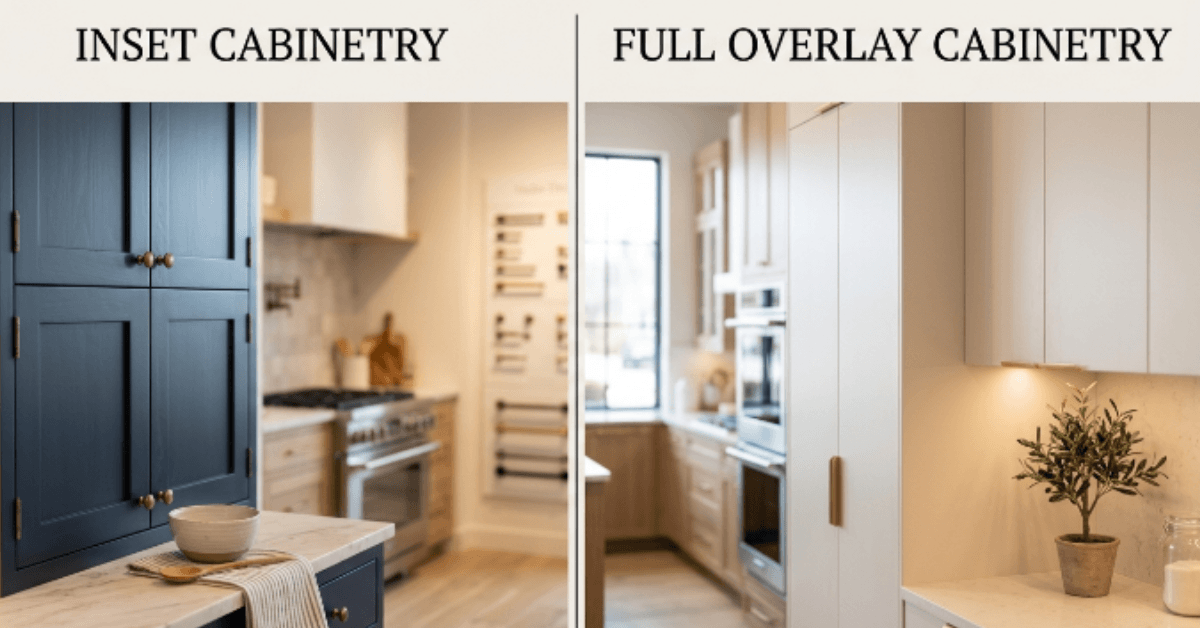
So, you’re stuck on inset vs overlay cabinets for your remodel. Fair enough; it’s a big call. One changes how your kitchen looks. The other changes what you pay and how much room you get inside each cabinet. Most people jump straight to paint color or hardware and skip this part, but the door construction shapes almost everything else, including your budget.
What Are Inset Cabinets?
Inset cabinet doors sit inside the frame, pretty much flush with the wood all the way around. You close the door, and it falls into position, like a puzzle piece, no drama. There’s a small gap along the edge, maybe around a sixteenth of an inch. Nothing really sticks out past the frame either.
Building these takes patience. Every opening gets measured by hand, and every door gets cut to match it. Get the math wrong, and you end up with a crooked gap, or a door that won’t shut right. Inset work has always been a cabinetmaker’s job rather than something churned out on an assembly line.
People choose inset when they want that old-world, farmhouse, furniture look. It pairs especially well with raised panel doors and classic shaker style cabinets, which balance traditional detail with a cleaner, more timeless feel. You’ll see inset most in custom kitchens where the build quality is the point, not an afterthought.
Worth knowing upfront: inset doors move with the seasons. Wood swells a little in humid months and pulls back in dry ones. A well-built inset door plans for that with the right gap from day one, but it’s still something to expect down the road. Not a flaw exactly, just how solid wood behaves.
What Are Overlay Cabinets?
Overlay flips the setup. The door sits on top of the frame instead of inside it, covering part of the wood or most of it depending on the type.
Partial overlay leaves about an inch of frame showing around each door. Full overlay cabinets cover nearly the whole thing, just a thin line between doors. That cleaner look is a big reason full overlay has taken over so many new kitchens.
Overlay cabinet doors typically ride on hidden hinges, are pretty quick to nudge into place, and are simple enough to leave out of view. Since the door sits on the outside of the box rather than tucked inside, you end up gaining a bit more storage space too, because the frame isn’t taking away from the opening.
Inset Cabinets vs Overlay Cabinets
| Factor | Inset Cabinets | Overlay Cabinets | |
| Door position | Flush inside the frame | On top of the frame | |
| Look | Traditional, furniture-style | Modern, clean lines | |
| Cost | 15–30% more | Lower cost | |
| Storage | Slightly less | Slightly more | |
| Hinges | Visible or hidden | Mostly hidden | |
| Humidity | Can stick, more sensitive | Adjusts easier | |
| Best fit | Farmhouse, historic kitchens | Modern, transitional kitchens | |
A few things worth pulling from that table:
- Inset takes longer to build since tight tolerances slow everything down
- Overlay tends to be the more budget-friendly pick for most remodels
- Full overlay gets you a near-seamless look without inset pricing
- Seasonal humidity hits inset doors harder than overlay
- Durability comes down to materials and installation quality more than door position alone
Which One Actually Fits Your Kitchen?
It comes down to three things: look, budget, and storage. Answer those honestly, and the choice usually makes itself.
Pick inset if:
- You want that furniture-grade, traditional feel
- You’re doing farmhouse, colonial, or historic style
- Budget isn’t your tightest constraint
- You’re staying long term and want something timeless
Pick overlay if:
- You want modern or transitional
- You need the budget to stretch further
- Storage space is tight
- You want hardware that’s easy to fix later without calling in a pro
Plenty of people mix it too, an inset island with full overlay everywhere else. It looks great when it’s done right and adds contrast without going overboard. We covered a few of those combinations in our cabinet door design ideas post if you want to see it in practice.
Living With the Choice Long Term
You’ll open these doors a few hundred times a week for years, so it’s worth thinking past how they look in photos. Inset kitchens age like good furniture. A little wear just adds character, and the flush surface doesn’t show scuffs the way you’d expect. Overlay ages differently. The exposed corners take the hits first, but hidden hinges make fixes quick and cheap- no big deal.
Neither one is a bad call for a busy household. Got kids running through the kitchen constantly? Overlay’s lower maintenance usually wins out. Restoring an old house, or building the kitchen you want to keep forever? Inset’s finish is hard to beat. Just think about how you actually use the space day to day, not how it’ll look on move-in day, and you’ll know pretty fast which one you want.
Final Thoughts
There’s no single winner between inset vs overlay cabinets. There’s really no single winner between inset and overlay cabinets. Inset gives you that kind of craftsmanship and a sort of flush, premium finish, especially when paired with custom-made cabinets for a tailored look. Overlay tends to come with a lower price, easier upkeep, and a little more room inside each cabinet. Your kitchen’s style, your budget, and how much maintenance you actually want to deal with later should steer it, not trends or what your neighbor picked. Either way, if you know the tradeoffs upfront, there are fewer surprises once the doors get hung, and that’s the part people forget.
Frequently Asked Questions
What is the difference between inset and overlay cabinets?
Inset doors sit flush inside the frame, so the whole surface reads as one smooth plane. Overlay doors sit on top of the frame instead, covering it partly or all the way. That’s the main split, and it’s why inset feels more traditional while overlay reads as modern.
Are inset cabinets more durable than overlay cabinets?
Not exactly; they just wear differently. Inset can stick a bit when humidity shifts since the doors sit so close to the frame. Overlay handles that better because the hinges are easy to adjust. Honestly though, how long either one lasts depends way more on the materials and who installed them.
Which cabinet style is more expensive?
Inset, by a good margin. Expect to pay 15% to 30% more than overlay. That extra cost is really just paying for the precision and time it takes to get those tight, even gaps right.
Do overlay cabinets provide more storage space?
Yes, a little. Since the door hangs outside the frame instead of tucking inside it, the frame doesn’t cut into the opening as much. Not a huge difference, but it adds up across a full kitchen.
Which cabinet style is better for modern kitchens?
Full overlay, hands down, if modern is the goal. It gives you that clean, almost seamless front. Inset can still work in a modern space, but it naturally leans more traditional, so it’s a better fit for farmhouse or historic-style homes.
Are inset cabinets worth the extra cost?
Depends what you’re after. If you want that furniture-grade look and you’re not moving anytime soon, most people say yes without hesitation. If you’re trying to stretch a budget or just want doors that are dead simple to maintain, overlay gets the job done for less.