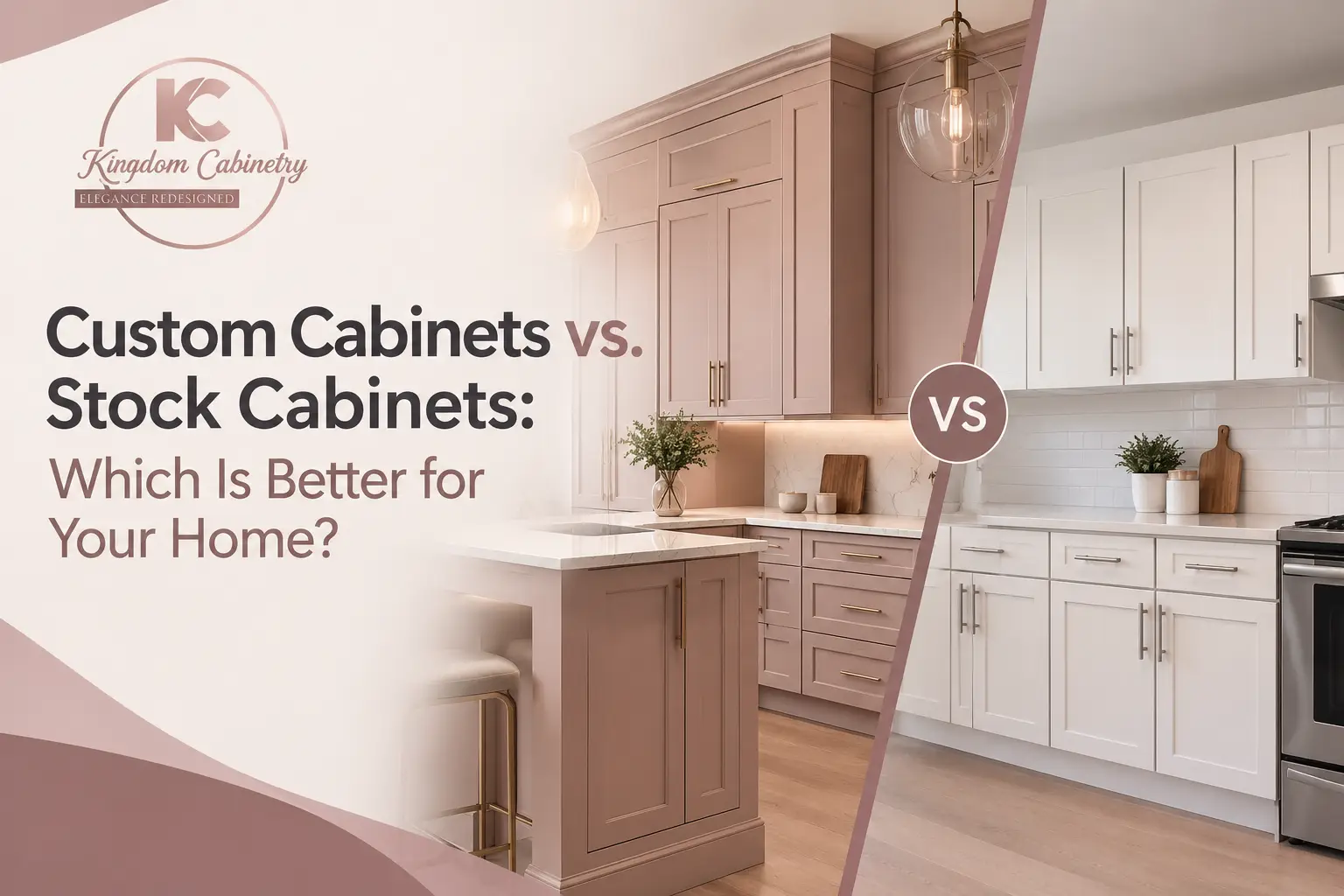
Cabinetry influences how organized, comfortable, and functional an entire home feels. Stock cabinets provide a practical solution through standard sizes, ready-made finishes, and faster availability. However, because they’re built for general use, they may leave awkward gaps, require filler panels, or offer storage that doesn’t fully match the room.
Custom cabinets are designed around the home rather than asking the home to adapt to standard cabinet sizes. They can improve storage in kitchens, bathrooms, bedrooms, closets, home offices, laundry rooms, mudrooms, garages, entertainment areas, and other overlooked spaces. Every detail from dimensions and materials to finishes, hardware, and interior organization is planned around the room and the homeowner’s routine.
Choosing between custom cabinets vs stock cabinets isn’t simply about comparing prices. It’s about deciding whether a quick, standardized solution meets the home’s needs or whether a precise fit, greater personalization, and better use of space will provide stronger long-term value. So, let’s check out the perks of both.
What Is the Difference Between Custom and Stock Cabinets?
Stock cabinets are mass-produced in predetermined sizes, colors, and configurations. Homeowners select from an existing catalog rather than changing the design.
Custom cabinets are built-to-order. A cabinetmaker measures the room and builds around exact dimensions, appliances, storage needs, and preferred appearance.
Semi-custom cabinets sit between the two. They begin with a manufacturer’s standard system but may allow selected changes to sizing, finishes, door styles, or interior features.
Custom vs. Stock Cabinets at a Glance
| Consideration | Stock cabinets | Custom cabinets |
| Sizing | Standard cabinet sizes | Built to exact project dimensions |
| Design choices | Limited catalog | Broad customization |
| Room fit | May require fillers | Designed around walls and appliances |
| Storage | Standard interiors | Personalized storage options |
| Availability | Usually faster | Longer design and production period |
| Price | Lower initial cost | Higher initial investment |
| Best use | Standard layouts and tight timelines | Unique layouts and personalized spaces |
Quality varies within both categories, so labels don’t reveal full value.
Understanding Stock Cabinets
Stock cabinetry comes in common size increments. Installers use filler strips or end panels where walls don’t match them. That can work in a straightforward kitchen layout but leave wasted space in unusual rooms.
Stock Cabinet Advantages
- Lower starting price: Standardized manufacturing generally reduces production expense.
- Shorter lead time: Popular colors and sizes may already be warehoused.
- Simpler selection: A limited range can make decisions easier and faster.
- Suitable for standard rooms: Stock cabinets may fit well when walls, ceilings, and appliances align with standard sizes.
- Useful for temporary priorities: They can suit rentals, quick updates, or projects with a fixed budget.
Stock doesn’t automatically mean poor quality. Review materials, box thickness, joints, slides, hinges, and warranty. A strong stock line may outperform a poorly specified expensive product.
Limitations of Stock Cabinets
Limited sizing reduces design flexibility. Sloped ceilings, angled walls, and awkward spaces may require compromises. Standard cabinets can leave appliance gaps or storage-free fillers.
Colors, profiles, accessories, and cabinet hardware are restricted to the manufacturer’s catalog. That works when the available design fits the room and goals.
Understanding Custom Cabinets
Custom cabinetry begins with the room and client. Cabinet dimensions, doors, and interiors can follow the architecture and routine.
Custom Cabinet Advantages
- Precise fit: Made-to-measure cabinets can meet walls, ceilings, windows, and appliances more intentionally.
- Better use of space: Narrow pull-outs, fitted corners, and specialized cabinets can turn difficult areas into useful storage.
- Greater personalization: Clients can select materials, finishes, profiles, hardware, and functional details.
- Purposeful interiors: Drawers, dividers, tray storage, appliance garages, and waste pull-outs can be sized for specific belongings.
- Architectural consistency: Cabinetry can coordinate with trim, built-ins, and the home’s overall character.
The tradeoffs are price and lead time. Designing and producing unique cabinetry takes longer than shipping stocked products.
Comparing Materials and Construction Quality
Cabinet quality depends on its specifications. Box materials include plywood, particleboard, and MDF. Each can work when its grade, thickness, and application are suitable.
Plywood’s bonded layers offer strength and screw-holding ability. Particleboard is common in cost-conscious lines. MDF provides a smooth surface for painted components. Solid wood may be used for frames, doors, fronts, or trim.
Look beyond the material name when assessing construction quality:
- How are cabinet boxes joined and reinforced?
- Are drawer bottoms and backs adequately supported?
- Do slides match the expected load?
- Are hinges adjustable and replaceable?
- Are exposed edges sealed and finished?
- What does the warranty cover?
Construction, finishing, and accurate installation work together. Premium materials can’t correct poor assembly.
Design, Finish, and Hardware Choices
Stock lines offer selected door styles, colors, and hardware. This simplifies decisions but may require accepting the closest available match.
Custom cabinetry offers greater personalization. Clients can coordinate wood, finish, profile, trim, and cabinet hardware, plus lighting or appliance panels.
Review samples in the home’s lighting and finalize details before fabrication.
Fit, Storage, and Everyday Functionality
The clearest difference between stock vs custom cabinets often appears in daily use. Stock interiors are designed to serve many households. Custom interiors can reflect the items and habits of one household.
In small kitchens, custom sizing can reduce fillers and adapt to tight corners. In simple rooms, stock boxes may provide adequate fit and functionality for less.
List cookware, food, appliances, and supplies, then test where they’ll go. More cabinets don’t always mean more accessible storage.
Are Custom Cabinets Better Than Stock Cabinets?
Custom cabinets may be better when the room has unusual dimensions, every inch of storage matters, or the homeowner wants control over design and construction. Their potential durability and tailored function can provide meaningful long-term value in a home intended for years of use.
Stock cabinets may be better when speed and affordability are the main priorities and the room suits standard sizing. These stock cabinet advantages shouldn’t be dismissed simply because custom work offers more flexibility.
Which Is Better, Custom or Stock Cabinets?
The answer depends on four questions:
- Does the room align with standard sizes?
- Which storage and design features are essential?
- What budget and timeline are realistic?
- How long is the cabinetry expected to serve the home?
Our professional custom cabinet maker can measure the room and explain where made-to-fit work would create meaningful value. The same approach extends beyond kitchens; custom built-in furniture can turn alcoves, walls, and other difficult areas into functional features.
The best choice in the custom vs stock cabinets debate is the one that fits the home, priorities, and resources without paying for benefits that won’t be used. Compare written specifications, not just showroom appearances or bottom-line prices. That’s the clearest way to see what each option truly provides for your household now and over the coming years.